Visitor Levy in England
What a Tourist Charge Could Mean for Town Centres and Local Growth
The Visitor Levy: Why This Conversation Matters Now
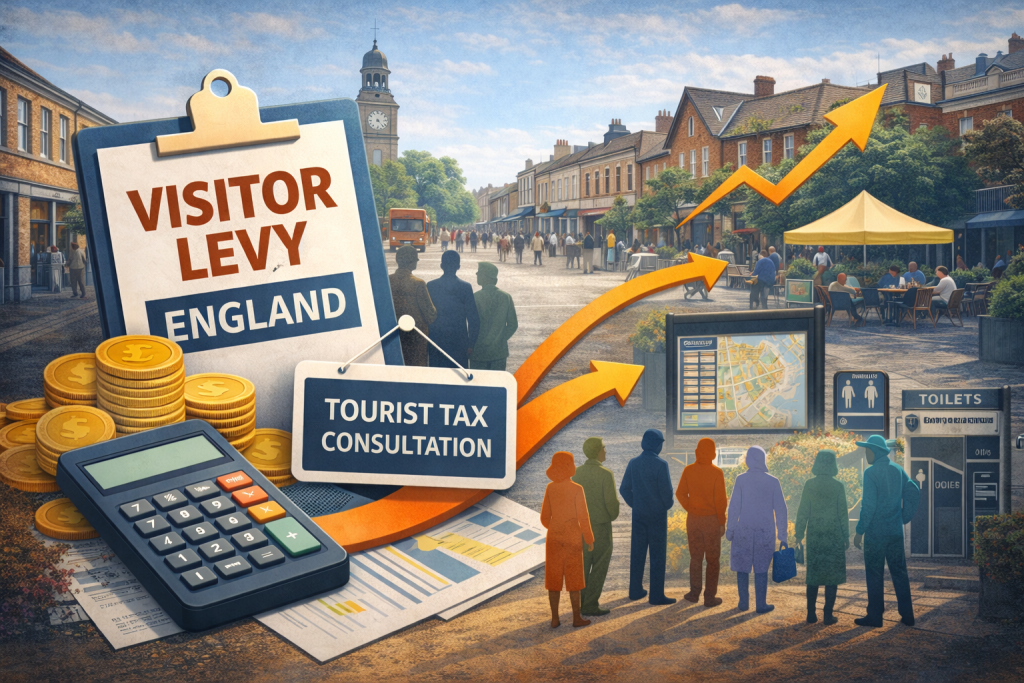
A new government consultation proposes giving English mayors the power to introduce a visitor levy — a small charge on overnight accommodation, with revenue retained locally. The Visitor Levy in England consultation, published by the Department for Levelling Up, Housing and Communities, is currently seeking views on how such a levy might work in practice.
At first glance, this may appear to be a narrow tourism policy issue. In reality, it represents something much rarer in local government finance: the potential creation of a new, locally controlled revenue stream, rather than the redistribution or rebranding of existing funding.
For town centres and high streets — particularly in places with strong visitor economies — the implications could be significant.
What Is Being Proposed?
Under the consultation, mayoral areas would be given the power to introduce a modest per-night charge on overnight stays. This would typically be collected via hotels, guesthouses and short-term accommodation providers.
It is important to be clear about how this would work in practice.
The levy would be paid by visitors, not by businesses. Accommodation providers would act as collection agents, passing the charge on as part of the cost of an overnight stay and remitting it to the relevant authority. In effect, the levy would function as a small increase in the price of accommodation for tourists, rather than a direct contribution from local businesses.
Revenue raised would be retained locally and intended to support the visitor economy and the impacts associated with it.
Versions of visitor levies already exist, or are being introduced, in parts of Scotland and Wales, where revenue is also intended to support local services and place quality. What is distinctive in the English context is the way the proposal is being positioned alongside wider devolution and local fiscal reform — framing the levy not just as a tourism mechanism, but as a locally controlled tool that could support town centre management, public realm and broader place-based outcomes.
Why Visitor Levies Matter for Town Centres
Visitors play a critical role in the health of many town and city centres. They drive footfall, spend and evening-economy activity, supporting retail, hospitality and cultural venues.
At the same time, visitor growth places additional pressure on local infrastructure and services. This includes cleaning and waste management, transport and wayfinding, public toilets, public realm maintenance, safety and night-time management.
These costs are often absorbed by councils without any direct mechanism to recoup them, particularly in places with seasonal tourism or high concentrations of short-term lets.
A locally retained visitor levy offers a way to more directly connect visitor spend with place quality, funding the everyday interventions that help town centres function well for residents and visitors alike.
This Is About Place Management, Not Just Tourism
Although framed as a tourism policy, the visitor levy has wider implications for economic development and regeneration.
If designed and implemented well, levy revenue could support the kinds of interventions that are difficult to fund through traditional capital-led regeneration programmes. This includes ongoing town centre management, public realm maintenance, safety initiatives, wayfinding, events, markets and cultural programming.
These interventions may not always be high-profile, but they have a disproportionate impact on how places feel and perform. In that sense, the levy has the potential to become a revenue backbone for place management, supporting the fundamentals that underpin footfall, confidence and investment.
Trust, Design and Visibility Will Determine Success
Because the levy is paid by visitors rather than businesses, the central challenge is less about cost burden and more about legitimacy, transparency and delivery.
Experience from BIDs and other place-based mechanisms shows that stakeholders are often supportive of contributions when the purpose is clear, governance feels local, and benefits are visible. While the visitor levy is not a business contribution in the same way a BID levy is, the comparison is still useful: acceptance depends on clarity of purpose and confidence that funds are being reinvested into improving the places people experience.
For accommodation providers, the key considerations are likely to be simplicity of administration and confidence that the levy will not undermine competitiveness. For visitors, the test will be whether the charge feels proportionate and justified by the quality of place they encounter.
Where schemes are transparent, simple and clearly reinvested, they are more likely to be understood as a practical tool rather than an imposition.
Governance and Geography Still Matter
One of the most important questions raised by the consultation is how levy revenue would be governed and allocated.
This includes how decisions are made about spend, how outcomes are reported, and how closely revenue raised in specific towns or city centres is reinvested locally, rather than being diluted across wider administrative areas.
As devolution and local government reorganisation continue to evolve, these questions remain unresolved. Ensuring that any future levy remains visibly connected to the places generating it will be critical to maintaining confidence and support, regardless of the final governance structure.
What This Consultation Phase Is Useful For
At this stage, the visitor levy remains a proposal rather than a confirmed policy. Most councils will not — and should not — commit significant resource until there is greater clarity from government.
However, the consultation phase still provides a valuable opportunity to feed delivery-focused insight into the design of any future scheme.
For regeneration, place and economic development teams, this may include reflecting on where visitor pressure is already felt in town centres, what types of investment are hardest to fund through existing mechanisms, and what principles would matter most if a levy were ever introduced.
This is less about preparing for implementation, and more about ensuring that if new local fiscal tools do emerge, they are shaped by delivery reality rather than theory.
A Measured Opportunity
The visitor levy is not a silver bullet for town centre funding. It will not replace national regeneration programmes or solve structural challenges overnight.
But it represents a rare opportunity: a potential locally controlled, recurring revenue source tied directly to place quality and visitor experience.
Handled carefully, it could quietly fund the basics that make town centres work — the things that rarely attract capital grants, but matter most to confidence, footfall and long-term vitality.
The consultation phase is the moment when councils and combined authorities still have influence over how — and whether — that opportunity is realised.
Related reading
👉 Business Rates 2026: What the Revaluation Means for High Streets — and What Councils Should Do Now