.svg)
Week 7, 2025 Retail Parks: Steady Footfall Amid Regional Variations
UK Retail Parks Week 7, 2025 show steady footfall with Scotland up 5.2% week-on-week. Footfall data reveals stability amidst evolving retail trends.

February 27, 2025
4 min read
Table of contents

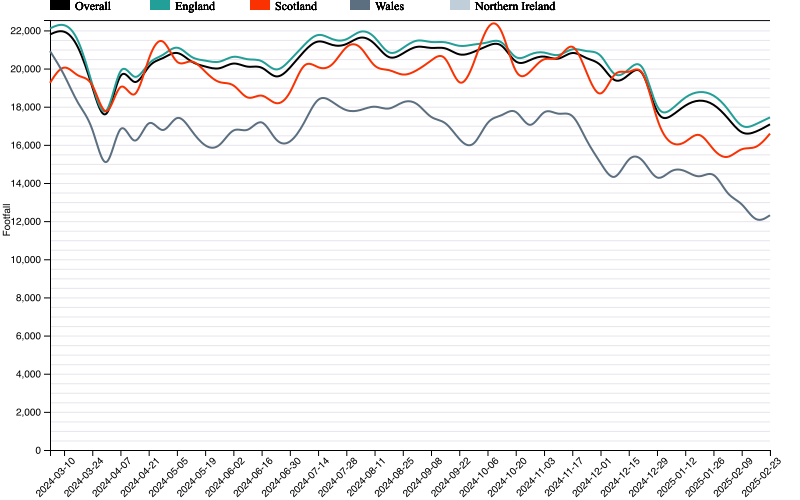
UK retail parks maintained a steady pace during Week 7, 2025, with average daily footfall holding at 16,700 visitors. Although short‐term figures have shown little variation from the previous period, the long‐term view indicates a notable decline compared with the same period last year. This measured performance points to both stability in the short term and lingering challenges over the longer timeframe that are affecting the retail sector overall. Reliable footfall analytics confirm these observations.
Regional Breakdown
Breaking down the regional data, retail parks in England continue to draw an average of 17,000 visitors per day. Despite a slight softening in week on week performance and a notable decline over the year, the figures remain resilient amid persistent market pressures and competitive footfall retail conditions. In Wales, the daily average stands at 12,000 visitors. Here, the market enjoyed a modest weekly uptick of 2%, even though the year on year trend reveals a notable decline.
Meanwhile, Scotland's retail parks recorded approximately 16,300 visitors per day and experienced a clear week on week increase of 5.2%. The pace of change in Scotland appears more robust, while the year on year decline remains more moderate when compared to the other regions. These footfall data findings highlight regional variations that are key for understanding overall footfall statistics.
Dwell Time Insights
Turning to dwell time – a secondary metric offering insight into visitor engagement quality – the overall figure remained at 71 minutes per visit, with a small weekly improvement and moderate yearly increase. In England, the average visit duration held consistently at 71 minutes, recording steady improvements over both short and longer timeframes. In contrast, retail parks in Wales experienced a slightly lower average visit duration at 69 minutes with a week on week decrease, although over the year the figures lift more sharply.
Scotland once again stands out with an average visit duration of 73 minutes, benefiting from a notable recent rise and a sharp year on year increase. This enhanced experience for visitors supports the narrative behind current footfall retail trends.
Retail Industry Adjustments
This data should be considered in the context of ongoing retail industry adjustments. Several recent news stories reported closures of well-known retailers that traditionally operate from retail park locations. For instance, an article from Metro detailed the closure of an Iceland store in Derby, a move that comes as part of a wider trend in store closures across the country. Similarly, Daily Express reported on closures at outlets associated with WHSmith, New Look and Homebase.
Other coverage by The Sun highlighted the news of a prominent health store announcing plans for shutdown. These operational changes may be contributing factors to the observed footfall trends as shoppers adjust their routines in response to evolving service offerings.
Economic and Weather Impacts
Recent UK economic news also hints at a cautious consumer mood. An article from Grocery Gazette notes that consumer confidence has reached a new low, with rising costs weighing on household budgeting decisions. This contrasts with discussions in Retail Week, which suggest that while wages are rising, the benefits of these increases have yet to fully translate into consumer spending. Adding further complexity to the economic picture, Investing.com UK recently indicated that retail sales are falling more than initially forecast, supporting the narrative of a restrained consumer market.
Weather conditions over the period have contributed additional context to the retail performance. Reports from Manchester Evening News and Birmingham Live detail episodes of freezing rain, snow, and heavy downpours. Such conditions have likely impacted travel and discretionary shopping, especially in more northerly areas, adding an extra layer of challenge for retail park managers. The changing weather has undoubtedly affected footfall statistics and overall consumer patterns.
Industry Commentary and Conclusion
Joe Capocci, spokesperson for Huq Industries, commented on the latest figures: "While we continue to see overall stability week on week, the underlying long‐term decline highlights a gradual change in consumer behaviour. The regional disparities, especially the performance in Scotland, underscore the importance of regional dynamics in the retail market. We remain committed to delivering high‐quality location intelligence to help our clients navigate these challenges."
In conclusion, the latest data for Week 7, 2025 underlines stable yet evolving consumer patterns in UK retail parks. With overall footfall levels remaining steady despite underlying yearly declines, and with notable variations emerging across England, Wales, and Scotland, this period reflects both continuity and change. Coupled with insights from the retail industry, economic and weather news, the sector faces challenges but also opportunities as it adapts to shifting consumer patterns and external pressures.
About Huq Industries
Huq Industries is the leading provider of location intelligence across the UK, Europe, and the Middle East, specialising in delivering high-quality data insights on footfall, consumer behaviour, and retail performance. By leveraging advanced analytics, Huq Industries enables retailers and analysts to understand and respond to market trends effectively, ensuring they are well-equipped to navigate the changing landscape of high street and town centre commerce.
Get the latest intelligence for your locations
Visit StoreFrequently Asked Questions
Clear answers to the most common questions about movement intelligence, retail expansion, and location analytics.
Related Blogs and Insights


.svg)
Empowering strategic teams with the world's most accurate and accessible location intelligence.
Contact

.svg)