.svg)
Where Else Do Your Visitors Shop? Competitive Intelligence for Retail and CRE
What is competitive intelligence in retail? How competitive data on footfall, catchment overlap and visitor crossover shows who you really compete with.

October 14, 2026
9 min read
Table of contents
Most retailers know a great deal about the people who buy from them. Till data, loyalty schemes and e-receipts show what customers bought, when, and how much they spent. What almost none of that data shows is everything that happens on either side of the transaction: where those same customers were before they walked in, where they went afterwards, and how often they chose a competitor instead.
That blind spot matters more than it looks. The retailer down the road isn't only competing for the same customers, it's competing for the same visits, the same catchment and, increasingly, the same sites. This guide explains what competitive intelligence actually means for a retail business, why your own customer data can't provide it, and how movement data answers the question most competitor analysis never gets round to asking: where else do your visitors shop?
What is competitive intelligence?
Competitive intelligence is the practice of gathering and analysing information about your market and the businesses competing in it, so that you can make better decisions about your own. In retail, that usually means understanding how rival stores, brands and destinations are performing, who they're attracting, and how their presence affects yours.
Three related terms get used almost interchangeably, and it's worth separating them:
- Competitor intelligence is the narrower idea: information about specific, named rivals. How busy is their flagship? Which towns are they opening in? Who visits their stores?
- Competitive intelligence is the wider discipline: the competitors themselves, plus the market context around them, such as shifts in footfall across a high street, changes in a catchment, or a new destination pulling visitors away from an established one.
- Competitive data is the raw material: the footfall counts, catchment maps, visit frequencies and spend figures. Competitive insight is what that data becomes once someone has asked the right question of it, and it changes a decision.
The distinction between the last two is the one that matters most in practice. Plenty of retail teams have competitive data sitting in a folder somewhere. Far fewer turn it into competitive insight that actually shapes where they open, how they trade, or which stores they keep.
Why your own data can't tell you about your competitors
First-party data is excellent at describing your own customers inside your own stores. By definition, it stops at your front door. A loyalty scheme can tell you that a customer visits twice a month; it can't tell you that the same person visits a competitor four times a month and only comes to you when the other store is out of stock.
Traditional sources of competitor intelligence help fill some of the gap, but each one only shows part of the picture:
- Store visits and mystery shopping show what a competitor's store looks like on a given afternoon, not how it performs over a year.
- Annual reports and trading updates give a company-wide view, rarely broken down to the individual store or catchment you're actually worried about.
- Broker and agent intelligence is useful, but it's anecdotal, and often comes with an interest in the outcome attached.
- Pricing and range monitoring tells you what a competitor sells, not who's buying it or where they came from.
None of these can answer the questions that shape location decisions: how many people visit that store, where do they travel from, how long do they stay, how often do they come back, and how many of them also visit you?
The question that changes the analysis: where else do your visitors shop?
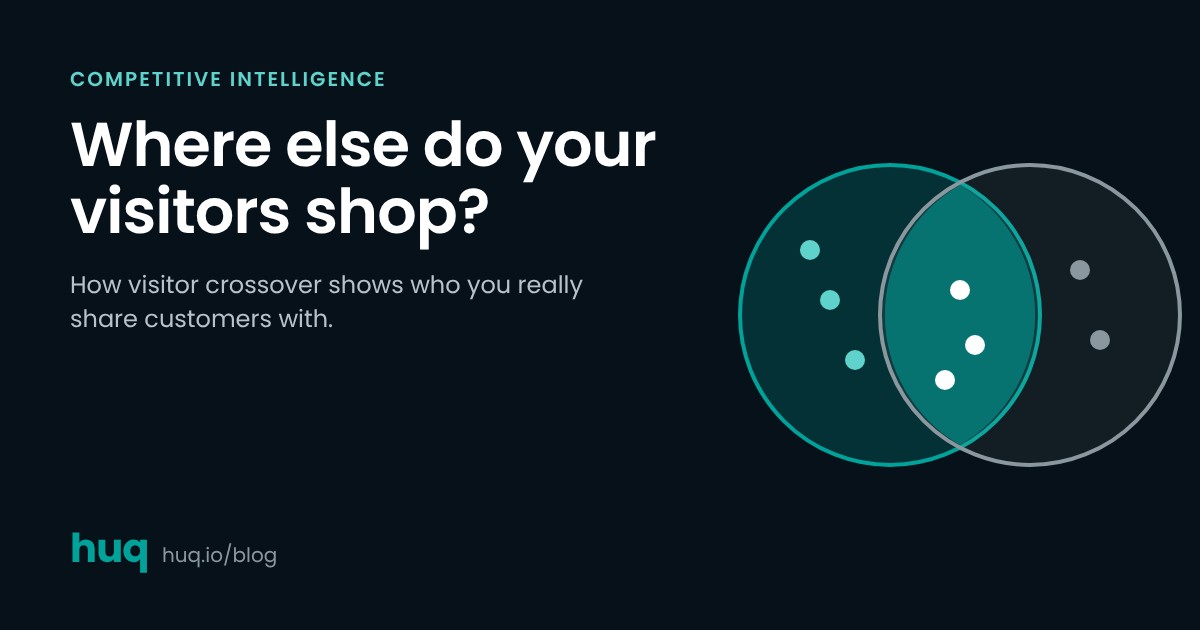
Visitor crossover, sometimes called cross-shopping or cross-visitation, looks at the share of people who visit your store and also visit another location, whether that's a direct competitor, a neighbouring retailer or a rival shopping destination. It's one of the most useful forms of competitive insight available to a retail team, because it replaces assumptions about who you compete with by evidence of who you actually share customers with.
The answer is often not what the team expected. A coffee chain may assume its main competitor is the other chain across the road, and find that a much larger share of its morning visitors also stop at an independent bakery by the station. A fashion retailer may benchmark itself against the brand it considers its closest rival, when its visitors are far more likely to be cross-shopping at a sportswear store two doors down.
Knowing where else your visitors shop tells you:
- Who your real competitors are, based on shared customers rather than shared categories.
- Which neighbours help you, where overlap with a complementary retailer is bringing people to your door rather than taking them away.
- Where you're losing visits, when a growing share of your catchment is choosing another destination.
- Which locations to prioritise, since a new site next to a store your visitors already use can behave very differently from one next to a store they avoid.
The competitive signals worth tracking
Useful competitor intelligence rarely comes from a single metric. It comes from asking the same handful of questions about your stores and your competitors' stores, using the same data, so that the comparison is genuinely like for like.
Tracked over time, these signals show not just where you stand today, but which way the market is moving, and whether a competitor's gain is coming at your expense or from new demand altogether.
Putting competitive insight to work
Competitive intelligence only earns its place when it changes a decision. In retail, it tends to change five in particular.
Choosing where to open next
A catchment can look like perfect whitespace until you see that a competitor already captures most of the visits your brand would depend on. Equally, a location that looks crowded on a map can turn out to have plenty of unmet demand once you look at how visitors actually behave. Competitive presence is one of the core criteria in any serious retail whitespace analysis, and it's measured in visits and overlap, not just in the number of rival logos on a street.
Diagnosing an underperforming store
When sales fall, the first question is whether the problem is the store or the street. If overall footfall in the area is steady but a competitor's share is rising, you have a competitive problem, and the fix is about proposition, range or experience. If footfall across the whole area is falling, the challenge is the location itself. Getting that diagnosis right is the difference between investing in the right fix and spending money on the wrong one.
Responding to a competitor opening or closing
A new competitor store nearby is easy to worry about and hard to measure. Tracking your footfall share, visit frequency and visitor crossover before and after the opening shows exactly how much, if any, of your trade it has taken, and whether that effect is settling down or growing. The same logic works in reverse: when a competitor closes, it shows how much of its trade you're actually picking up.
Sharpening local marketing
Knowing where a competitor's visitors travel from shows which postcodes are worth targeting, and which of your own catchment areas are most exposed. Marketing spend can be pointed at the areas where you're losing share, rather than spread evenly across a radius drawn on a map.
Making the board case
A store opening, relocation or closure case is far stronger when it shows how the site compares with competing stores nearby, not just with your own network. Competitive benchmarking is often the part of the evidence a board scrutinises hardest, and it's covered in more depth in Building the Board Case for Your Next Store (or Closure).
For landlords and asset managers, the same data works from the other side: visitor crossover shows how tenants feed each other, which competing schemes share your visitors, and how your centre benchmarks against them when it comes to leasing conversations and rent reviews.
Common mistakes in retail competitor analysis
A handful of errors come up often enough to be worth naming:
- Benchmarking against the wrong competitor set. The rival you think about most isn't always the one your customers visit most. Let visitor crossover define the competitor set, not category labels.
- Comparing numbers from different sources. Your own footfall from door counters, a competitor's from a broker's estimate and an area figure from a council report aren't measuring the same thing. Competitive data only works when every location is measured on the same basis.
- Treating a snapshot as a trend. A single study shows a moment. Competitive position shifts week by week, particularly around openings, closures, refurbishments and seasonal peaks.
- Confusing presence with pull. A competitor having a store nearby doesn't mean it's drawing your customers. What matters is the share of visits, the overlap in catchment, and how often visitors choose one over the other.
What to look for in a source of competitive data
If competitive intelligence depends on comparing like with like, then the data behind it needs to hold up to that comparison. A few things make the difference:
- One consistent dataset for your stores and your competitors', so that differences in the numbers reflect differences in performance, not differences in how they were counted.
- Coverage across your markets, so that a competitor comparison in Manchester and one in Madrid mean the same thing.
- Regular updates, so that you see the effect of a competitor opening in weeks rather than waiting for next year's report.
- Validated figures, so that the numbers stand up when someone in a board meeting or a lease negotiation asks how confident you are in them.
- A self-serve interface, so that a property or expansion manager can answer a competitive question directly, without waiting on an analyst or commissioning a consultancy study.
Where Huq fits in
Huq's platform gives retail teams the same view of their competitors' stores as they have of their own. Footfall share, catchment overlap, visitor crossover, dwell time, visit frequency, demographics and, in the UK, spend all come from one consistent dataset, so a competitor benchmark compares like with like rather than stitching together figures from different providers.
That dataset is validated on an ongoing basis against external, authoritative figures, and covers 22 countries across the UK, Europe, the Middle East and beyond. Because the platform is genuinely self-serve, an expansion or estates team can benchmark any site against its own network and against competing stores and destinations in minutes, rather than waiting weeks for a one-off competitor study that's already out of date when it arrives.
The result is competitive insight you can act on: knowing who you really compete with, where you're winning and losing visits, and what that means for your next opening, your next lease renewal, or the store you're not sure about.
Your customers already know which of your competitors they visit, how often, and why. Competitive intelligence is simply how you find out too. See how Huq benchmarks any location against your network and your rivals, from one validated platform, so the next decision about opening, trading or closing starts from where your visitors actually go.
Frequently Asked Questions
Clear answers to the most common questions about movement intelligence, retail expansion, and location analytics.
Related Blogs and Insights
.svg)
Empowering strategic teams with the world's most accurate and accessible location intelligence.
Contact

.svg)