.svg)
Week 39 2025 Retail Parks Footfall Update – Location Analytics Insights
UK Retail Parks saw modest gains with a 4.2% weekly rise in footfall and 8.6% annual uplift in dwell time. Location analytics and location intelligence reveal encouraging retail trends.

October 9, 2025
2 min read
Table of contents
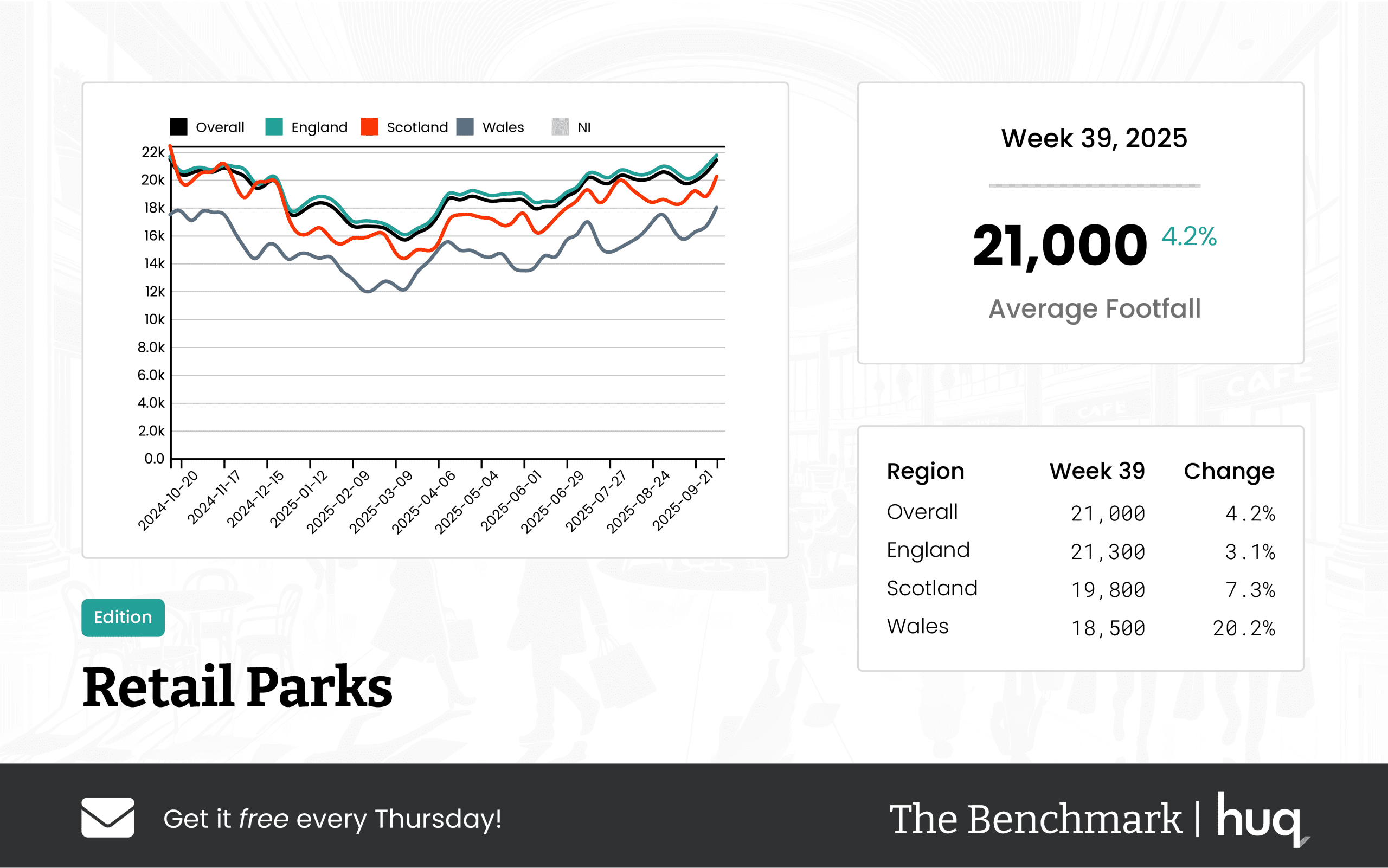
UK Retail Parks have experienced positive trends during Week 39, with overall footfall figures showing encouraging improvements. The average daily visits have risen to 21,000, marking a 4.2% week-on-week increase and a 1.2% rise compared to the same period last year. Although current visit duration averaged 76 minutes—a slight decline of 2.6% from the prior week—annual performance shows an 8.6% uplift in dwell time. These trends underscore enhanced consumer engagement and the positive dynamics of the retail environment.
In England, the largest market by footfall, consumer activity remained steady with an average of 21,300 daily visits. The region recorded a modest improvement of 3.1% week on week and a 1.5% year-on-year rise in visits. While dwell time in England measured at 79 minutes, there was a slight weekly drop of 2.5%. However, when comparing year-on-year data, dwell time impressively increased by 12.9%, reflecting more sustained consumer engagement in the English retail parks.
Scotland's retail parks enjoyed a robust week with an impressive 7.3% week-on-week increase, reaching an average of 19,800 daily visits. Despite this rise in footfall, visitor engagement was less pronounced, with an average visit duration of just 51 minutes—a significant decline of 16.4% over the week, indicative of a softening trend in consumer dwell times compared to previous periods.
Wales presented an interesting scenario. While the average daily footfall was slightly lower at 18,500, the region experienced a sharp increase in weekly visits along with buoyant year-on-year performance. However, the average dwell time of 60 minutes showed modest weekly improvements but suffered a notable decline when viewed on an annual basis.
Joe Capocci, spokesperson for Huq Industries, commented on the trends: "The sharp increase in footfall observed in Wales, which mirrors recent retail industry news, highlights an evolving consumer landscape that is both dynamic and responsive." This insight from industry experts reinforces the notion that evolving consumer behaviors and enhanced location analytics are key to understanding and leveraging retail trends in the UK.
Media: For all media and press enquiries, please contact media@huq.io
About Huq Industries
Huq Industries is the leading provider of location intelligence across the UK, Europe, and the Middle East, specialising in delivering high-quality data insights on footfall, consumer behaviour, and retail performance. By leveraging advanced analytics, Huq Industries enables retailers and analysts to understand and respond to market trends effectively, ensuring they are well-equipped to navigate the changing landscape of high street and town centre commerce.
Get the latest intelligence Benchmark update each Thursday!
Frequently Asked Questions
Clear answers to the most common questions about movement intelligence, retail expansion, and location analytics.
Related Blogs and Insights


.svg)
Empowering strategic teams with the world's most accurate and accessible location intelligence.
Contact

.svg)