.svg)
Week 39 2025 Major Retail Centres – Footfall Retail Performance Update
UK major retail centres show a moderate overall improvement in footfall retail despite a slight weekly dip. Footfall data reveal annual rises around 10% amid steady long‐term trends.

October 9, 2025
2 min read
Table of contents
Overall Performance
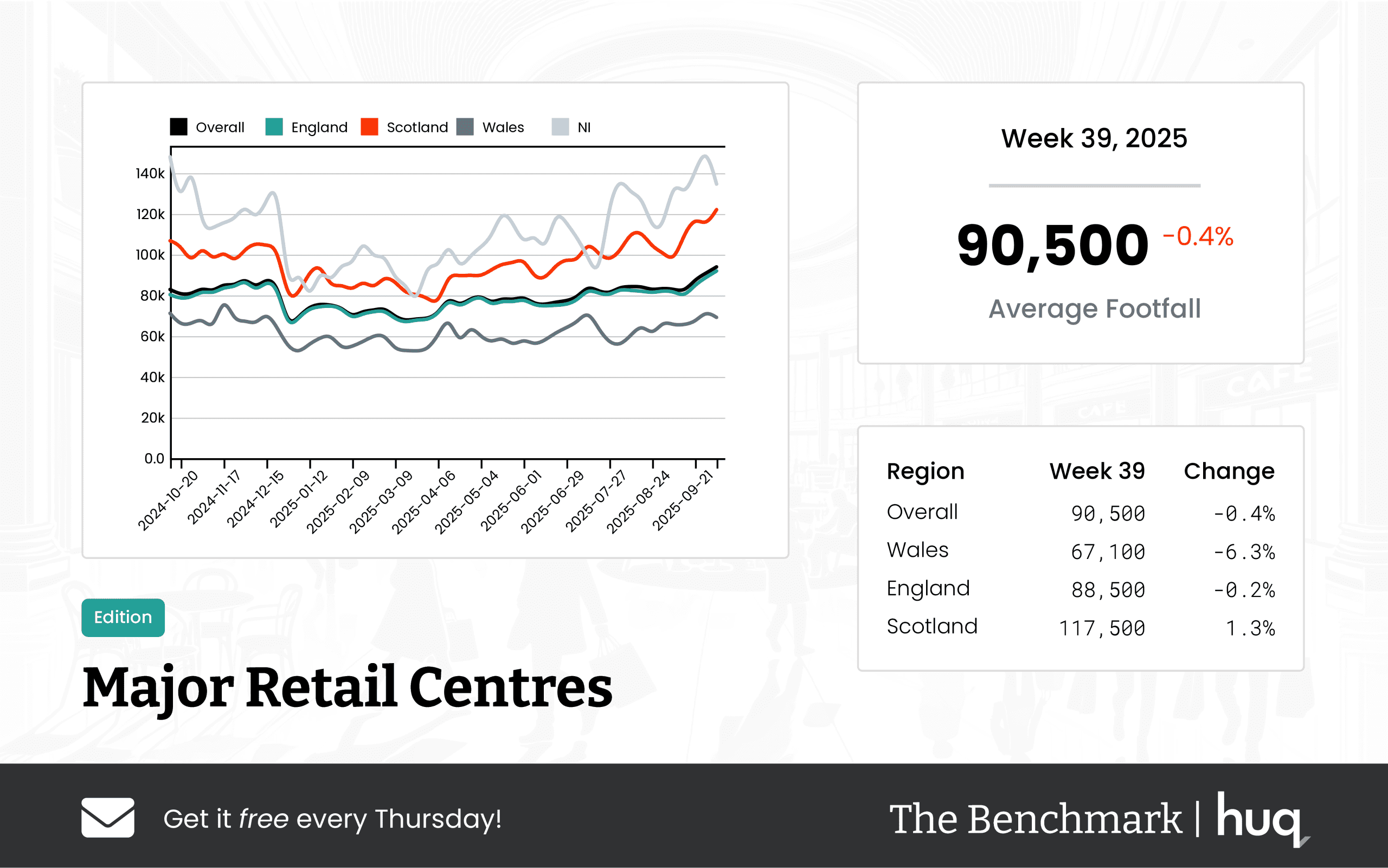
Overall performance across UK Major Retail Centres during the week ending 2025‑10‑05 shows an average daily footfall of 90,500. While there has been a slight drop in week-on-week figures, the year‑on‑year outlook indicates a moderate improvement in visitor numbers. This overall result, derived from The Benchmark weekly monitor, confirms that long‑term trends remain positive even when recent performance is mixed. Robust footfall retail trends continue to underpin the sector.
Regional Analysis
Regional analysis reveals divergent trends across the UK. In England, centres experienced an average of 88,500 daily visitors. The week saw negligible change, while the year‑on‑year growth of 10% demonstrates steady performance in the region. Scotland’s retail centres outperformed with an average of 117,500 daily visitors, recording a modest week-on‑week increase and an annual rise of 11.3%. These figures underline the strong consumer engagement in Scotland. In contrast, retail centres in Wales attracted an average of 67,100 daily visits; week‑on‑week, the region experienced a sharper drop, and the annual figure shows a slight softness.
Analytical Insights
Key insights were derived using footfall data, footfall analytics and footfall statistics, providing a holistic perspective on visitor trends.
Consumer Behaviour
Dwell time metrics provide further insights into consumer behaviour. In England, the average visit duration was 128 minutes, reflecting a healthy progression over both the recent week and year‑on‑year comparisons. Scotland again leads with an average duration of 136 minutes, where the recent data not only recorded a marked improvement in visit duration but also exhibited a sharp increase on a year‑on‑year basis. Conversely, dwell times in Wales appear less robust, with an average duration of 97 minutes accompanied by weakening weekly and annual figures.
Comment
Commenting on these results, Joe Capocci, Huq Industries spokesperson, stated: “The most striking change is the marked improvement in footfall in Scotland, which is further supported by recent Retail Industry News observations about Glasgow’s performance.”
Media: For all media and press enquiries, please contact media@huq.io
About Huq Industries
Huq Industries is the leading provider of location intelligence across the UK, Europe, and the Middle East, specialising in delivering high-quality data insights on footfall, consumer behaviour, and retail performance. By leveraging advanced analytics, Huq Industries enables retailers and analysts to understand and respond to market trends effectively, ensuring they are well-equipped to navigate the changing landscape of high street and town centre commerce.
Get the latest intelligence Benchmark update each Thursday!
Frequently Asked Questions
Clear answers to the most common questions about movement intelligence, retail expansion, and location analytics.
Related Blogs and Insights



.svg)
Empowering strategic teams with the world's most accurate and accessible location intelligence.
Contact

.svg)