.svg)
Week 31, 2025 Local Retail Centres Performance Update: Location Analytics Insights
UK local retail centres show overall modest declines with a −0.3% weekly and −0.6% yearly shift, reflecting evolving footfall trends and steady visitor engagement using location analytics.

August 14, 2025
2 min read
Table of contents
Performance Overview
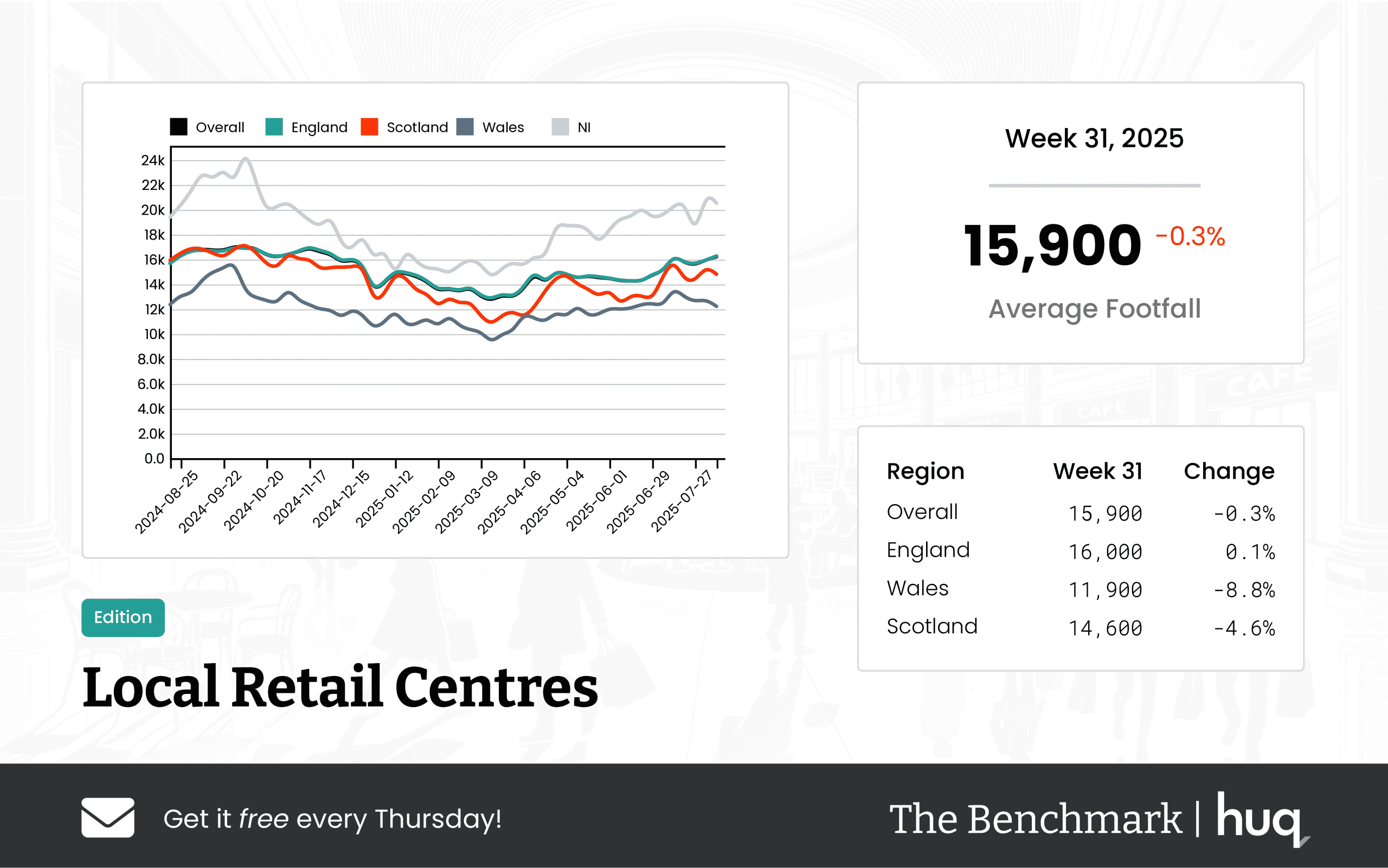
The latest figures for UK Local Retail Centres indicate an overall average daily footfall of 15,900, reflecting a slight weekly softening of −0.3% and a modest year‐on‐year decrease of −0.6%; these insights were derived using location analytics. Alongside the primary footfall data, the average visit duration was recorded at 94 minutes, with a weekly softening of 6.9% and a year‐on‐year increase of 10.6%, highlighting evolving visitor engagement and notable footfall trends. These results suggest steady overall visitation while urging a closer look at regional performance and shifts in the retail industry.
Regional Analysis
In England, centres recorded a resilient performance with an average daily footfall of 16,000, showing a slight increase of 0.1% week‐on‐week and nearly flat year‐on‐year change at −0.1%. Conversely, centres in Wales experienced lower activity with average daily visits of 11,900 and a noticeable weekly decline of −8.8% as well as a year‐on‐year drop of −6.3%. Scottish centres also fell behind with an average of 14,600 daily visits, as they witnessed decreases of −4.6% on a weekly basis and −9.9% over the past year, further emphasising regional performance differences within the retail industry.
Visitor Engagement
Dwell time remains an important secondary metric. Centres in England mirrored the overall average with visitors staying 94 minutes, albeit with a weekly drop of 6% balanced by an annual increase of 9.3%. In Wales, the average duration was higher at 118 minutes, even though it experienced a weekly decline of 9.2%; year‐on‐year figures point to a strong upward trend in visitor engagement, while Scottish centres reported an average visit length of 83 minutes, with the weekly softening reinforced by a modest annual increase.
Joe Capocci, Huq Industries Spokesperson, said: "The most striking change in footfall, especially the notable decline in Wales, is reflected in our data and supported by recent retail industry news reporting a major store closure."
Media: For all media and press enquiries, please contact media@huq.io
About Huq Industries
Huq Industries is the leading provider of location intelligence across the UK, Europe, and the Middle East, specialising in delivering high-quality data insights on footfall, consumer behaviour, and retail performance. By leveraging advanced analytics, Huq Industries enables retailers and analysts to understand and respond to market trends effectively, ensuring they are well-equipped to navigate the changing landscape of high street and town centre commerce.
Get the latest intelligence Benchmark update each Thursday!
Sign Up NowFrequently Asked Questions
Clear answers to the most common questions about movement intelligence, retail expansion, and location analytics.
Related Blogs and Insights


.svg)
Empowering strategic teams with the world's most accurate and accessible location intelligence.
Contact

.svg)