.svg)
Week 26 2025 Retail Parks Performance Update: Location Analytics Insights
UK retail parks recorded a modest 0.9% increase in daily visits with a 2.8% drop in dwell time. Updated location analytics reveals robust footfall trends.

July 10, 2025
2 min read
Table of contents
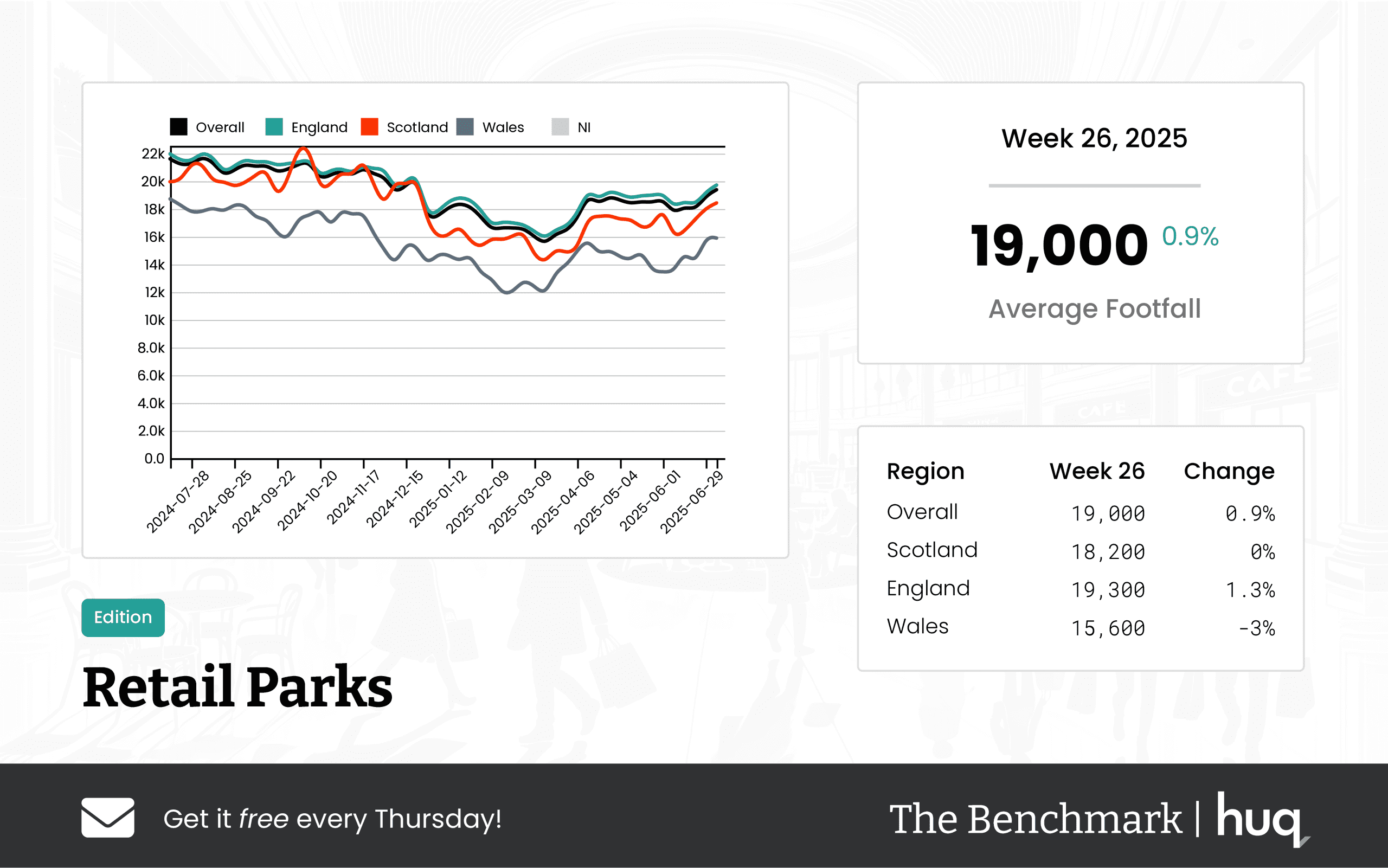
Leveraging cutting-edge location analytics, the latest update provides a comprehensive deep dive into the performance of UK retail parks. The insights drawn from The Benchmark reveal intriguing trends across footfall, dwell time, and regional performance, offering a valuable resource for industry stakeholders.
Overall Performance
UK retail parks have seen a slight uplift in footfall, with the average daily visits reaching 19,000 – a modest increase of 0.9% week-on-week. However, compared to the corresponding period last year, this figure is 10.4% lower. The dwell time metric tells a more nuanced story: despite a 2.8% drop during the recent week, the year-on-year figure shows a healthy 7.7% increase, indicating longer, more engaged visits over the long term.
Regional Breakdown
Detailed regional insights show that England is leading with an average of 19,300 daily visitors, marking a 1.3% increase on the week but still reflecting a 10.3% decrease when compared to last year. Welsh retail parks, drawing an average of 15,600 daily visitors, experienced a 3% decline over the past week along with a significant 12.2% year-on-year drop. Scotland maintained a steady weekly performance with 18,200 daily visits, though it experienced an 11.2% annual decline.
Engagement Metrics
In terms of customer engagement, the data paints a mixed picture. England’s retail parks have succeeded in maintaining a robust average visit duration of 73 minutes, with only minor weekly changes and a notable 14.1% improvement year-on-year. In contrast, both Scotland and Wales have seen shorter dwell times. Welsh parks average 62 minutes, and Scotland has experienced a downturn in visit duration, suggesting softer engagement trends in these regions.
Industry Comment
Joe Capocci, a spokesperson for Huq Industries, remarked, "The modest weekly recovery in English footfall, bolstered by recent images showing progress at Wynyard Retail Park, confirms that our data continues to offer essential insights despite an annual softness." His comments underscore the importance of nuanced location analytics in understanding market dynamics, even amid broader industry challenges.
This update reinforces the role of location intelligence in tracking performance metrics and highlights the need for stakeholders to continually adapt to evolving consumer behavior across different regions of the UK.
Media: For all media and press enquiries, please contact media@huq.io
About Huq Industries
Huq Industries is the leading provider of location intelligence across the UK, Europe, and the Middle East, specialising in delivering high-quality data insights on footfall, consumer behaviour, and retail performance. By leveraging advanced analytics, Huq Industries enables retailers and analysts to understand and respond to market trends effectively, ensuring they are well-equipped to navigate the changing landscape of high street and town centre commerce.
Get the latest intelligence Benchmark update each Thursday!
Frequently Asked Questions
Clear answers to the most common questions about movement intelligence, retail expansion, and location analytics.
Related Blogs and Insights



.svg)
Empowering strategic teams with the world's most accurate and accessible location intelligence.
Contact

.svg)