.svg)
Week 25, 2025 Shopping Centres: Robust Footfall Trends
UK Shopping Centres show steady footfall with modest weekly gains and minor yearly softness. Recent footfall data reveals consistent visitor trends.

July 3, 2025
2 min read
Table of contents
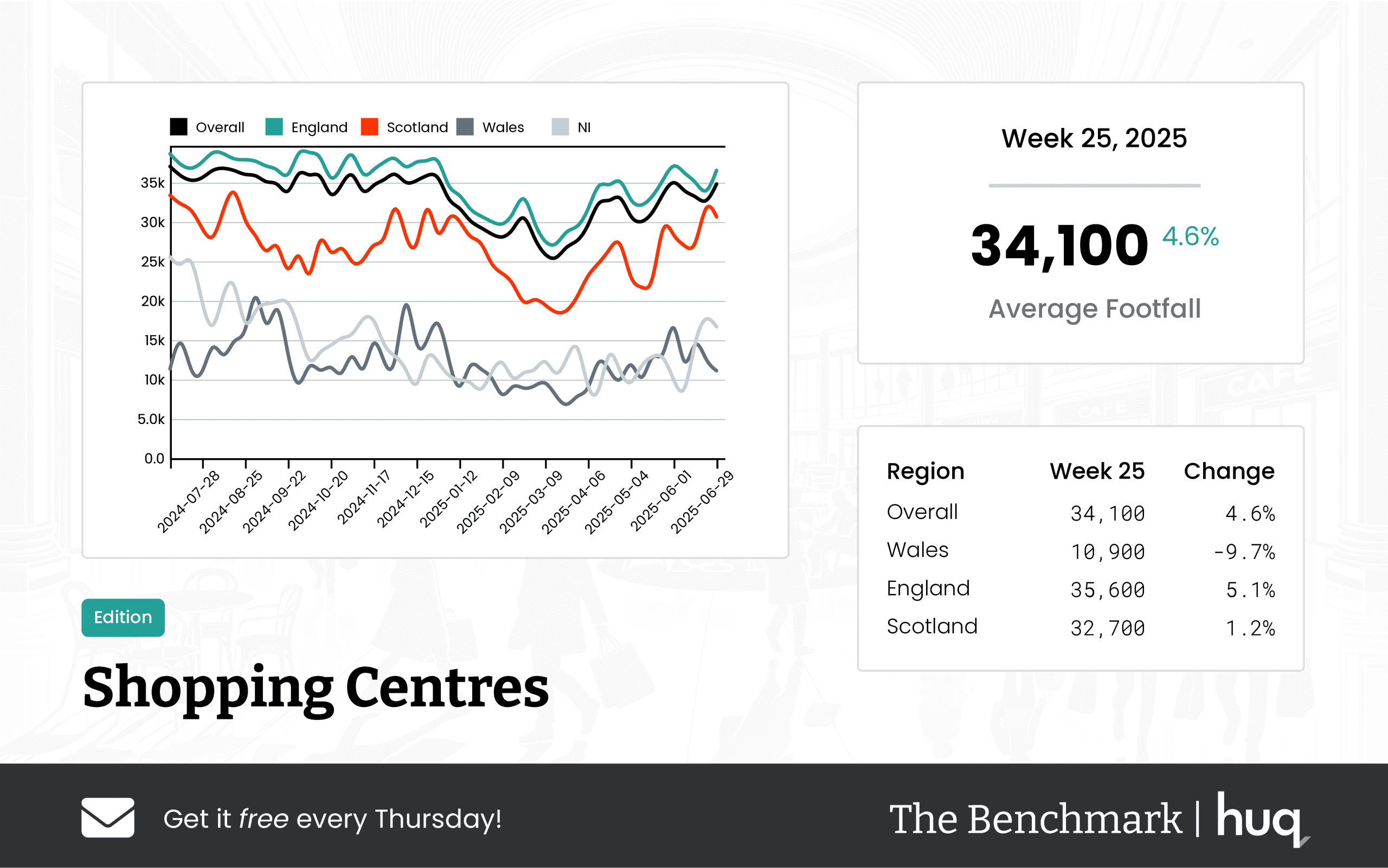
The latest data from The Benchmark reveals that UK Shopping Centres recorded an average daily footfall of 34,100 for the week ending June 29, 2025. With a week on week increase of 4.6% yet a slight 4.2% drop compared to the previous year, these figures underscore a generally steady level of visitor interest across the country.
In England, centres saw a robust performance with an average daily footfall reaching 35,600. A week on week rise of 5.1% was observed, contributing to a modest softness on a yearly basis. In contrast, Welsh centres experienced challenges, registering only 10,900 daily visitors alongside significant declines of 9.7% on a week on week basis and 7.3% year on year. Scottish centres, handling an average of 32,700 visitors daily, maintain stability with a slight week on week climb of 1.2% and modest yearly gains.
Delving into dwell time, shoppers across all centres spent an average of 100 minutes per visit. However, a week on week softening of 9.9% was noted even though the yearly figures remained largely stable. In England, the average visit stretched to 101 minutes despite a notable 13.7% decrease in the week on week metric, while Welsh centres lagged with a shorter average of 35 minutes and more significant footfall and dwell declines. Scottish centres led the pace by not only boasting the longest average visit duration of 103 minutes but also witnessing a positive 10.8% week on week change coupled with a sharp improvement over the year.
These figures come at a time when retail analytics emphasize the importance of precise footfall statistics and counting strategies in shaping agile, data‐driven responses. As retail investment initiatives continue to evolve, industry experts, including Joe Capocci, a spokesperson for Huq Industries, underscore the need for active and responsive management – particularly in regions like Wales where sharp declines suggest emerging challenges.
Overall, the report paints a picture of a diverse retail landscape, with each region presenting unique visitor trends that call for tailored strategies as the industry adapts to continually shifting market dynamics.
Media: For all media and press enquiries, please contact media@huq.io
About Huq Industries
Huq Industries is the leading provider of location intelligence across the UK, Europe, and the Middle East, specialising in delivering high-quality data insights on footfall, consumer behaviour, and retail performance. By leveraging advanced analytics, Huq Industries enables retailers and analysts to understand and respond to market trends effectively, ensuring they are well-equipped to navigate the changing landscape of high street and town centre commerce.
Get the latest intelligence Benchmark update each Thursday!
Frequently Asked Questions
Clear answers to the most common questions about movement intelligence, retail expansion, and location analytics.
Related Blogs and Insights


.svg)
Empowering strategic teams with the world's most accurate and accessible location intelligence.
Contact

.svg)