.svg)
Week 23 2025 Footfall Analytics Update: UK Local Retail Centres
UK local retail centres saw a modest 1.5% weekly rise in footfall analytics, despite a slight yearly drop. Overall, improved quality visits and steady footfall data highlight the trend.

June 19, 2025
2 min read
Table of contents
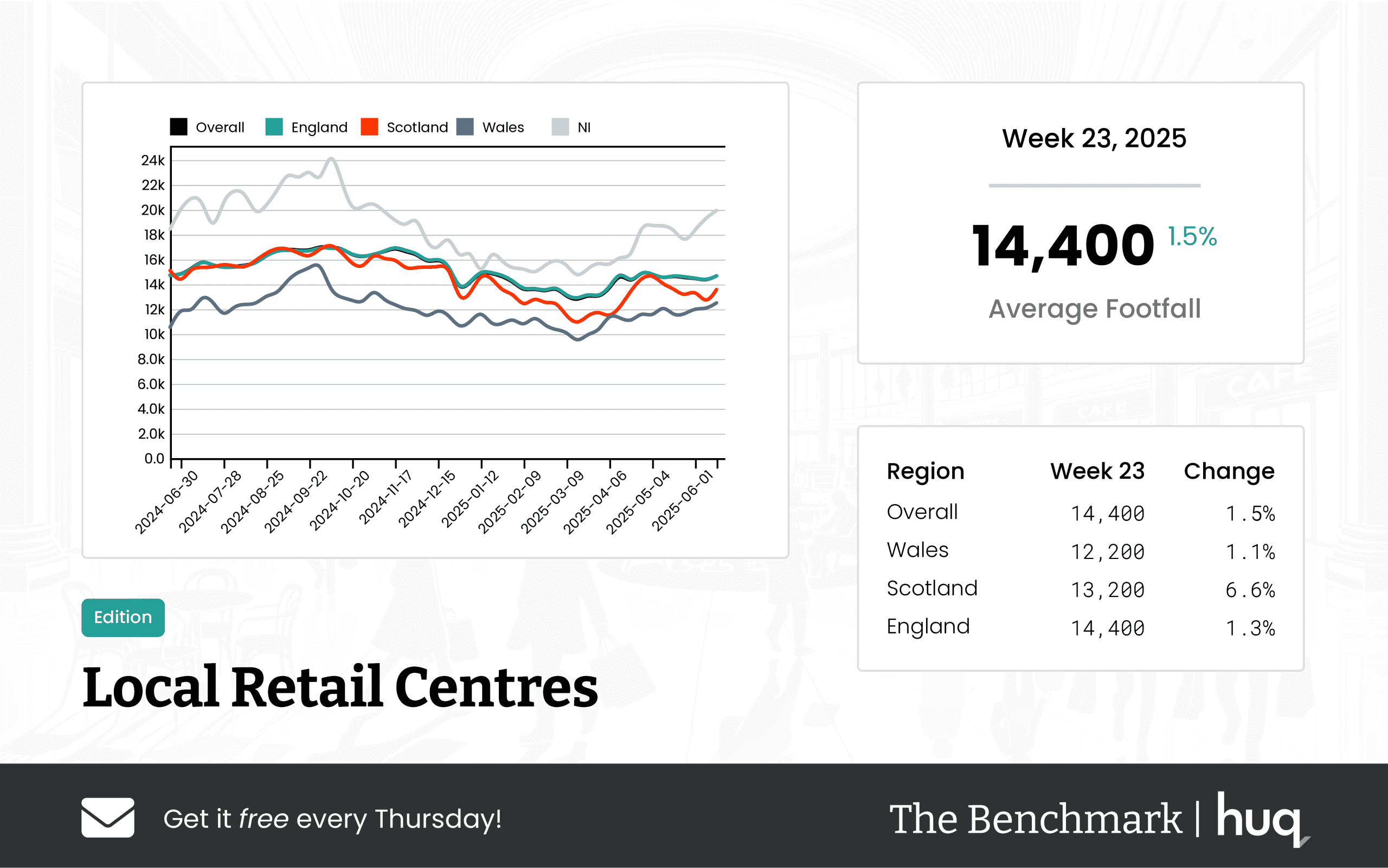
The latest footfall data for UK local retail centres has revealed a mixed yet generally upbeat performance for Week 23. Overall, the average daily footfall recorded was 14,400, representing a slight increase of 1.5% over the past week. Although this figure shows a year-on-year decline of 1.8%, there is a silver lining: the average dwell time has remained steady at 97 minutes per visit, accompanied by an impressive year-on-year boost of 18.3%. This suggests that while the number of visitors dipped slightly compared to last year, the quality and duration of visits significantly improved.
A closer look at regional performance introduces some interesting contrasts. Wales achieved an average daily footfall of 12,200, with figures rising by 1.1% on a weekly basis and surging by 7.6% year-on-year. The average dwell time in Wales was an impressive 141 minutes, marking an 8.5% rise over the week along with strong annual gains, underscoring the increasing visitor engagement.
Scotland, meanwhile, experienced a standout week with its average daily footfall rising to 13,200—up by 6.6% in one week, despite an 8.6% annual decline. The dwell time in Scotland improved significantly, clocking in at 109 minutes per visit and recording a robust 19.8% weekly uptick, suggesting that shoppers are spending considerably more time at these centres.
In England, the performance figures mirrored the overall trend. With an average daily footfall of 14,400, England saw a 1.3% weekly increase paired with a 1.8% dip year-on-year. The regional dwell time stood at 95 minutes, with a slight weekly decrease of 1% but a noteworthy year-on-year improvement of 17.3%. This data underscores a resilient retail market where customer engagement continues to improve even amid minor demographic shifts.
Joe Capocci, spokesperson for Huq Industries, commented on the fresh data: "The most striking change in footfall is Scotland’s 6.6% weekly increase, and the recent retail news—such as observations from the Whitgift Centre—supports the view that market dynamics are evolving steadily." His remarks reinforce the overall narrative: while raw numbers may fluctuate, the quality of visitor engagement and the strategic importance of evolving market dynamics remain strong indicators of robust retail performance in the UK.
Media: For all media and press enquiries, please contact media@huq.io
About Huq Industries
Huq Industries is the leading provider of location intelligence across the UK, Europe, and the Middle East, specialising in delivering high-quality data insights on footfall, consumer behaviour, and retail performance. By leveraging advanced analytics, Huq Industries enables retailers and analysts to understand and respond to market trends effectively, ensuring they are well-equipped to navigate the changing landscape of high street and town centre commerce.
Get the latest intelligence Benchmark update each Thursday!
Frequently Asked Questions
Clear answers to the most common questions about movement intelligence, retail expansion, and location analytics.
Related Blogs and Insights


.svg)
Empowering strategic teams with the world's most accurate and accessible location intelligence.
Contact

.svg)