.svg)
Week 22, 2025 Local Retail Centres – Footfall Update
Overall footfall dipped by 1.5% last week while dwell time improved by 2.1%, indicating a shift in consumer engagement at Local Retail Centres across the UK.

June 12, 2025
2 min read
Table of contents
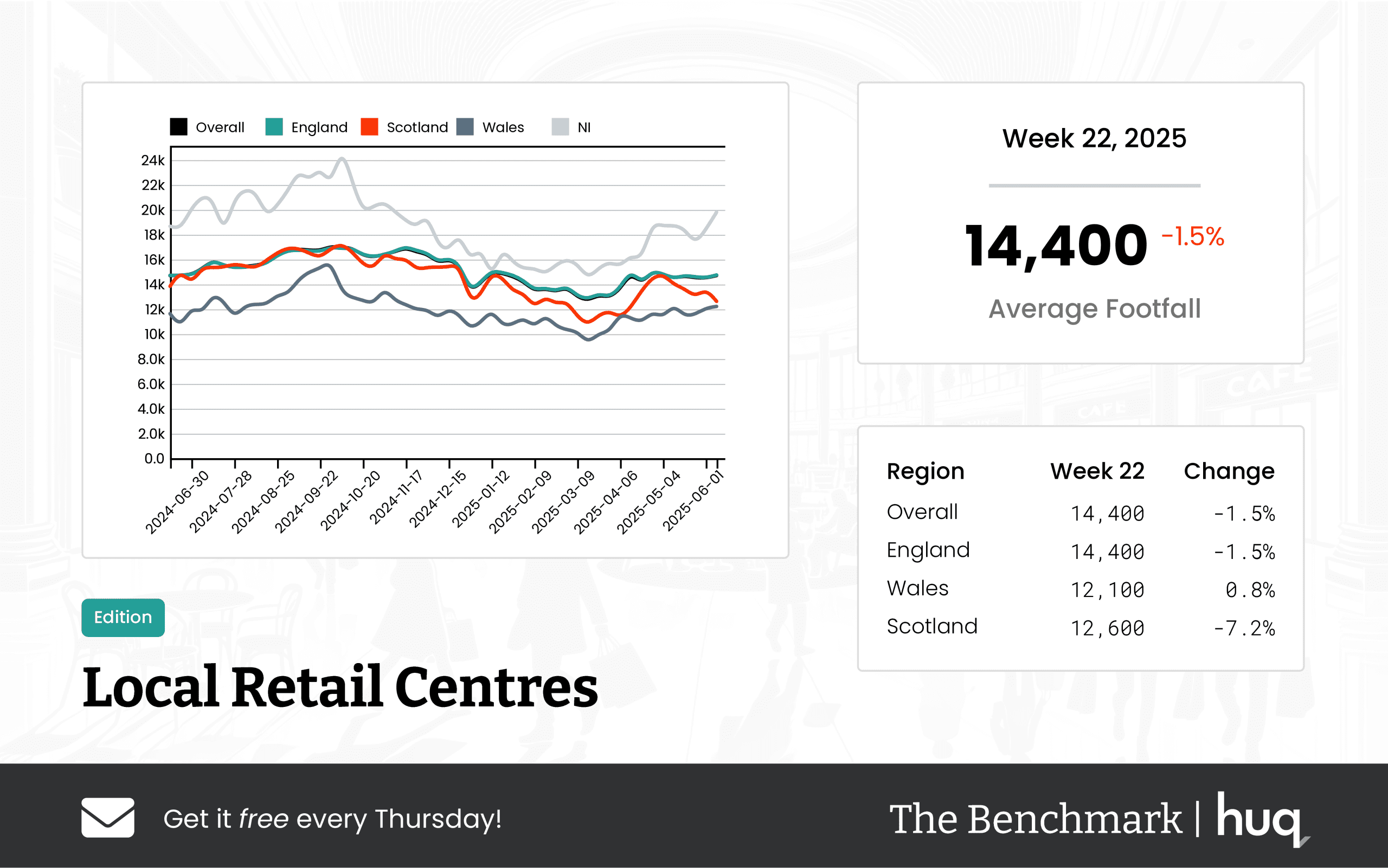
The latest figures from The Benchmark reveal a modest softening in overall footfall across UK Local Retail Centres, with an average of 14,400 daily visitors recorded for the week ending 2025‑06‑08. This represents a 1.5% decline from the previous week and a 2% drop compared to the same period last year.
Despite the downturn in visitor numbers, the average dwell time on site improved significantly, increasing to 97 minutes per visit – a 2.1% rise from the previous week and an impressive 18.3% year-on-year hike. These numbers suggest that while foot traffic is reduced, those who visit are spending more time engaging with the retail space.
A detailed regional breakdown provides additional insights. In England, retail centres maintained an average of 14,400 daily visitors, alongside a parallel 1.5% weekly decline and a slight 1.8% year-on-year reduction. However, English centres saw the average visit duration rise by 3.2% weekly, reaching 96 minutes, coupled with an 18.5% improvement compared to the previous year.
Wales presented a contrasting performance, with an average of 12,100 daily visitors, marking a modest week-on-week increase of 0.8% and a solid 6.4% uplift compared to last year. Dwell time in Wales was notably higher, averaging 130 minutes per visit. Scottish Local Retail Centres, however, experienced greater challenges; despite an average of 12,600 daily visitors, the region saw a steeper 7.2% weekly drop and a 13.3% annual decline, with an average visit duration of 91 minutes, evidencing a decrease in week-on-week performance despite a mild year-on-year recovery.
The data further underscores evolving consumer behaviour in retail settings. Detailed footfall analytics support these trends by highlighting enduring shifts in visitor patterns while also correlating with recent industry changes. Joe Capocci from Huq Industries commented on the regional disparities, particularly noting the significant declines in Scotland. He linked these changes to broader developments, such as recent investment announcements in Northern Ireland, which may be impacting regional retail dynamics.
Overall, while fewer people are visiting Local Retail Centres, the increased engagement during visits suggests a pivot towards quality over quantity in consumer interactions. This nuanced trend calls for ongoing monitoring as retail strategies adjust to shifting consumer habits.
Media: For all media and press enquiries, please contact media@huq.io
About Huq Industries
Huq Industries is the leading provider of location intelligence across the UK, Europe, and the Middle East, specialising in delivering high-quality data insights on footfall, consumer behaviour, and retail performance. By leveraging advanced analytics, Huq Industries enables retailers and analysts to understand and respond to market trends effectively, ensuring they are well-equipped to navigate the changing landscape of high street and town centre commerce.
Get the latest intelligence Benchmark update each Thursday!
Frequently Asked Questions
Clear answers to the most common questions about movement intelligence, retail expansion, and location analytics.
Related Blogs and Insights


.svg)
Empowering strategic teams with the world's most accurate and accessible location intelligence.
Contact

.svg)