.svg)
Week 19 2025 Major Retail Centres: footfall retail Trends
UK major retail centres enjoyed a steady recovery in footfall retail, with a modest 1.7% weekly increase and 6.6% year‑on‑year growth, indicating positive footfall analytics across the country.

May 22, 2025
2 min read
Table of contents
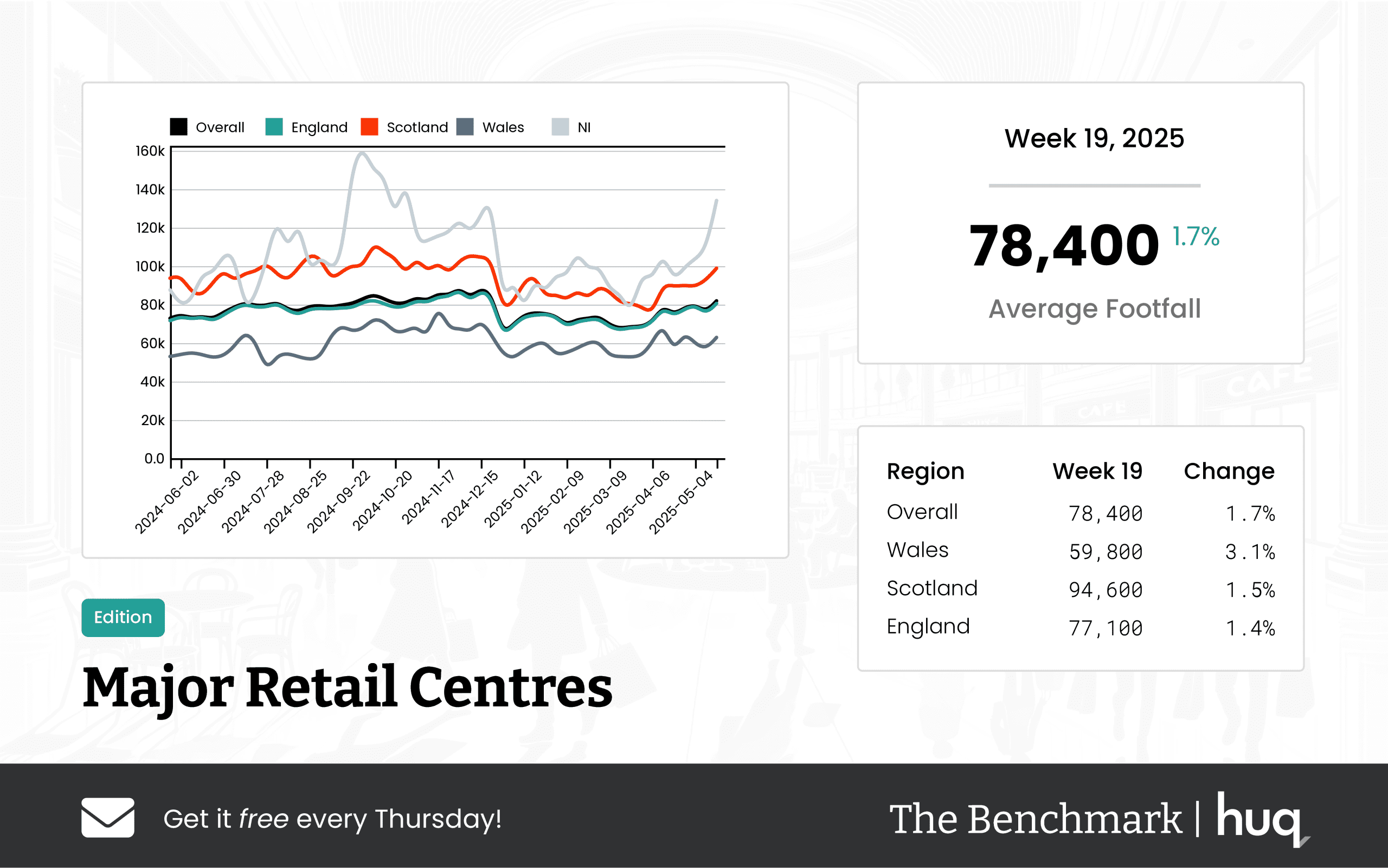
UK Major Retail Centres – Week 19 Performance Update
Data from The Benchmark Tracker (Week Ending 18 May 2025)
Overall Performance:
UK Major Retail Centres recorded an average daily footfall of 78,400 during the week ending 18 May 2025. This overall figure represents a moderate increase of 1.7% compared with the previous week and a 6.6% rise compared with the same week last year.
The consistent upward trend in footfall is a positive indication of growing consumer interest and a steady market recovery across the country. Analysis confirms that thorough footfall retail, detailed footfall analytics and comprehensive footfall statistics all point to this promising performance.
Regional Analysis:
Regional variations were notable in the latest data. In Wales, retail centres saw an average daily footfall of 59,800, reflecting a weekly rise of 3.1% and a year‑on‑year growth of 14.6%. Scotland reported the highest daily footfall at 94,600, with modest improvements of 1.5% week‑on‑week and 8.6% compared to the previous year. Meanwhile in England, centres recorded a mean of 77,100 daily visitors, with weekly footfall up by 1.4% and a 5.5% increase from the same period last year. These differences highlight recovery patterns that vary by region, with some centres showing more dynamism in gaining momentum.
Dwell Time Insights:
The data also provided insights into dwell time, with the overall average visit duration increasing to 116 minutes. This marks a steady year‑on‑year increase of 5.5%, even though there was no change compared with the previous week. In Wales, visitors spent an average of 97 minutes per visit, showing a notable weekly gain, albeit with a slight year‑on‑year decline. Scotland maintained a strong performance with an average dwell time of 133 minutes, accompanied by an 8.1% weekly improvement and a significant annual increase. In England, visitors averaged 115 minutes, although there was a softening of 1.7% over the last week, the yearly performance still indicated modest improvement.
Industry Comment:
“Among the regional metrics, the most striking change in footfall was observed in Wales, and recent retail expansion news supports our view of a steadily recovering market,” noted Joe Capocci.
This detailed performance update not only highlights the encouraging revival of footfall in the UK major retail centres but also underscores the importance of continuous monitoring using advanced footfall analytics to better understand and predict consumer trends.
Media: For all media and press enquiries, please contact media@huq.ioAbout Huq Industries
Huq Industries is the leading provider of location intelligence across the UK, Europe, and the Middle East, specialising in delivering high-quality data insights on footfall, consumer behaviour, and retail performance. By leveraging advanced analytics, Huq Industries enables retailers and analysts to understand and respond to market trends effectively, ensuring they are well-equipped to navigate the changing landscape of high street and town centre commerce.
Frequently Asked Questions
Clear answers to the most common questions about movement intelligence, retail expansion, and location analytics.
Related Blogs and Insights



.svg)
Empowering strategic teams with the world's most accurate and accessible location intelligence.
Contact

.svg)