.svg)
Week 17, 2025 High Streets & Town Centres Update: Insights from Location Analytics
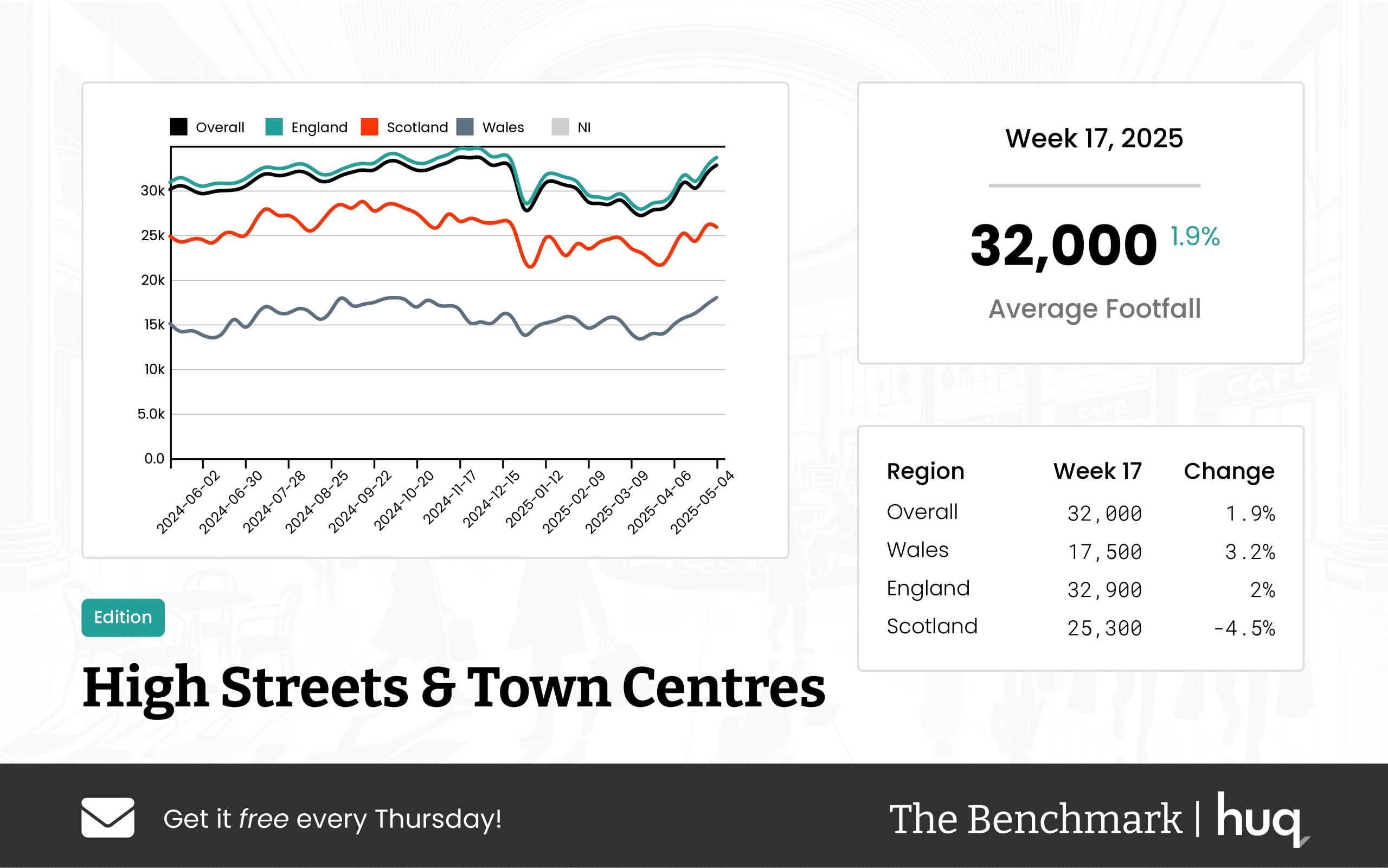
A moderate recovery is underway with footfall rising by 1.9% week on week and 5.7% year on year, reflecting trends in location analytics and location intelligence.

May 8, 2025
2 min read
Table of contents
Our recent analysis via location analytics confirms the figures and sets the scene for the detailed update ahead.
Latest Footfall Data
The latest figures for UK High Streets and Town Centres indicate a moderate recovery in customer visits with the overall average daily footfall reaching 32,000. This reflects a week on week gain of 1.9% and a year on year increase of 5.7%, demonstrating steady progress in retail visitation across the country. These numbers are a clear indication of evolving consumer behaviour and the gradual return of consistent market activity over the past week.
Regional Breakdown
A closer look at regional performance reveals a nuanced pattern. In England, the average daily footfall of 32,900 came with a modest week on week increase of 2% and an annual rise of 5.5%, suggesting that city centres and retail zones are steadily welcoming more visitors. Wales, meanwhile, recorded an average of 17,500 daily visitors, with a week on week improvement of 3.2% and a sharp increase in year on year footfall, underlining a strong longer term uplift in customer numbers. In contrast, Scotland saw an average daily footfall of 25,300. Despite a modest annual gain of 2.7%, some town hubs experienced a week on week drop of 4.5%, signalling a short-term softening in performance.
Dwell Time Analysis
Complementary to the visitor numbers, dwell time offers further insights into the quality of visits. Overall, the average visit duration remains at 100 minutes, reflecting continuity in customer engagement, with England mirroring this performance. In Wales, the average dwell time of 98 minutes has shown improvement, while Scotland experienced a decline to 94 minutes, suggesting more fleeting visits in that region.
Industry Comment
Joe Capocci, spokesperson for Huq Industries, said: "The notable week on week decline in Scotland's footfall, alongside a sharp increase in Wales and corroborated by recent retail industry developments such as Ikea's Oxford Street store launch, highlights evolving consumer dynamics in UK town centres." Additional insights from location intelligence have enriched our understanding of these trends.
Media: For all media and press enquiries, please contact media@huq.io
About Huq Industries
Huq Industries is the leading provider of location intelligence across the UK, Europe, and the Middle East, specialising in delivering high-quality data insights on footfall, consumer behaviour, and retail performance. By leveraging advanced analytics, Huq Industries enables retailers and analysts to understand and respond to market trends effectively, ensuring they are well-equipped to navigate the changing landscape of high street and town centre commerce.
Get the latest intelligence Benchmark update each Thursday!
Sign Up NowFrequently Asked Questions
Clear answers to the most common questions about movement intelligence, retail expansion, and location analytics.
Related Blogs and Insights


.svg)
Empowering strategic teams with the world's most accurate and accessible location intelligence.
Contact

.svg)