.svg)
Week 11, 2025 Shopping Centres Update: location analytics Perspective
UK shopping centres saw a 12.8% weekly footfall increase despite a 6.7% annual decline, signalling a cautious short‐term recovery amid subdued longer‐term trends, while consumer dwell time insights underscore evolving shopper behaviour.

March 26, 2025
2 min read
Table of contents
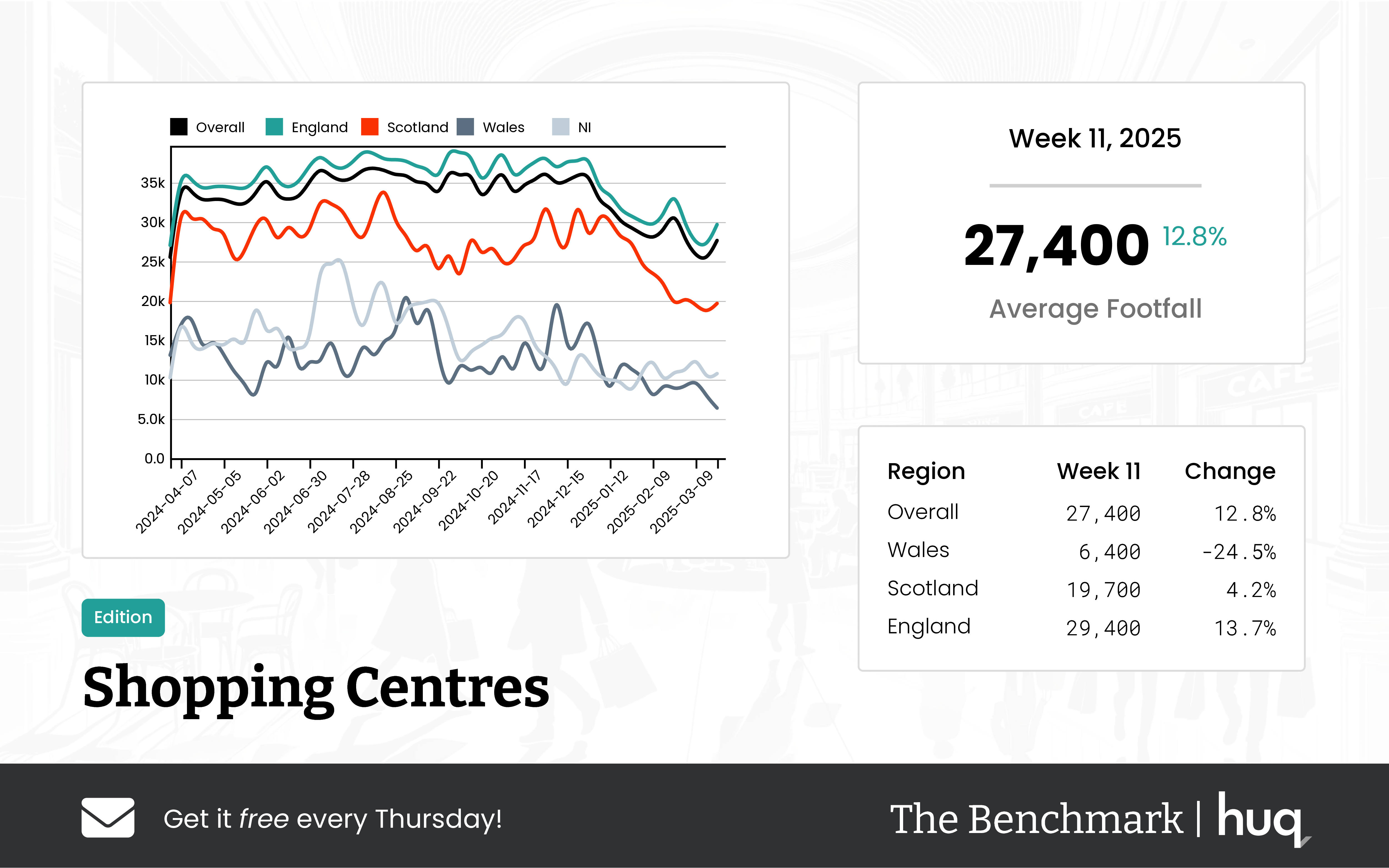
UK shopping centres recorded an average daily footfall of 27,400 during week 11, marking a moderate week on week rise of 12.8%. Despite this short‐term uptick, a year on year decline of 6.7% hints at underlying challenges that continue to affect overall visitor numbers.
Retailers are taking note of a significant change in shopper engagement: the average dwell time across venues stood at 113 minutes per visit—a weekly increase of 3.7% and an impressive year on year improvement of 17.7%. This trend suggests that even as overall visits have seen a slight dip over the year, consumers are spending more time in store, possibly engaging more deeply with in-store experiences.
A regional breakdown of the data provides further insights. In Wales, shopping centres experienced an average daily footfall of 6,400. The region saw declines both weekly and on a yearly basis, and the average duration of a visit was 90 minutes, reflecting lower levels of consumer engagement relative to other regions.
In contrast, Scotland’s centres posted an average daily footfall of 19,700, with modest increases of 4.2% week on week and 3.6% year on year. Shoppers in Scotland enjoyed a longer average dwell time of 121 minutes per visit, benefiting from a notable weekly uplift despite more moderate historical gains.
England leads the pack, boasting the highest average daily footfall at 29,400. Although England experienced a yearly decline of 5.3%, a healthy weekly increase of 13.7% underscores a dynamic retail landscape. With an average dwell time of 114 minutes per visit, the region also recorded a slight weekly increase and a strong year on year improvement in customer engagement.
Industry voices have commented on these trends. Joe Capocci, spokesperson for Huq Industries, noted, "The notable decline in footfall in Wales, coupled with observations from recent retail industry news, underscores the evolving dynamics of consumer engagement." These remarks echo a broader sentiment that, while short‐term recoveries are visible through increased dwell times and weekly boosts, long‐term challenges persist.
As the UK retail environment continues to evolve, these insights from location analytics provide a critical window into shifting consumer behaviour—helping retailers strategize and adapt in a competitive market landscape.
Media: For all media and press enquiries, please contact media@huq.io
About Huq Industries
Huq Industries is the leading provider of location intelligence across the UK, Europe, and the Middle East, specialising in delivering high-quality data insights on footfall, consumer behaviour, and retail performance. By leveraging advanced analytics, Huq Industries enables retailers and analysts to understand and respond to market trends effectively, ensuring they are well-equipped to navigate the changing landscape of high street and town centre commerce.
Get the latest intelligence Benchmark update each Thursday!
Sign Up NowFrequently Asked Questions
Clear answers to the most common questions about movement intelligence, retail expansion, and location analytics.
Related Blogs and Insights


.svg)
Empowering strategic teams with the world's most accurate and accessible location intelligence.
Contact

.svg)