.svg)
UK Shopping Centres – Week 40 (2025) Footfall Retail Update
UK Shopping Centres saw a 4.5% drop in footfall this week with overall footfall data indicating a 2.2% annual decline. Footfall analytics suggest evolving consumer habits.

October 16, 2025
2 min read
Table of contents
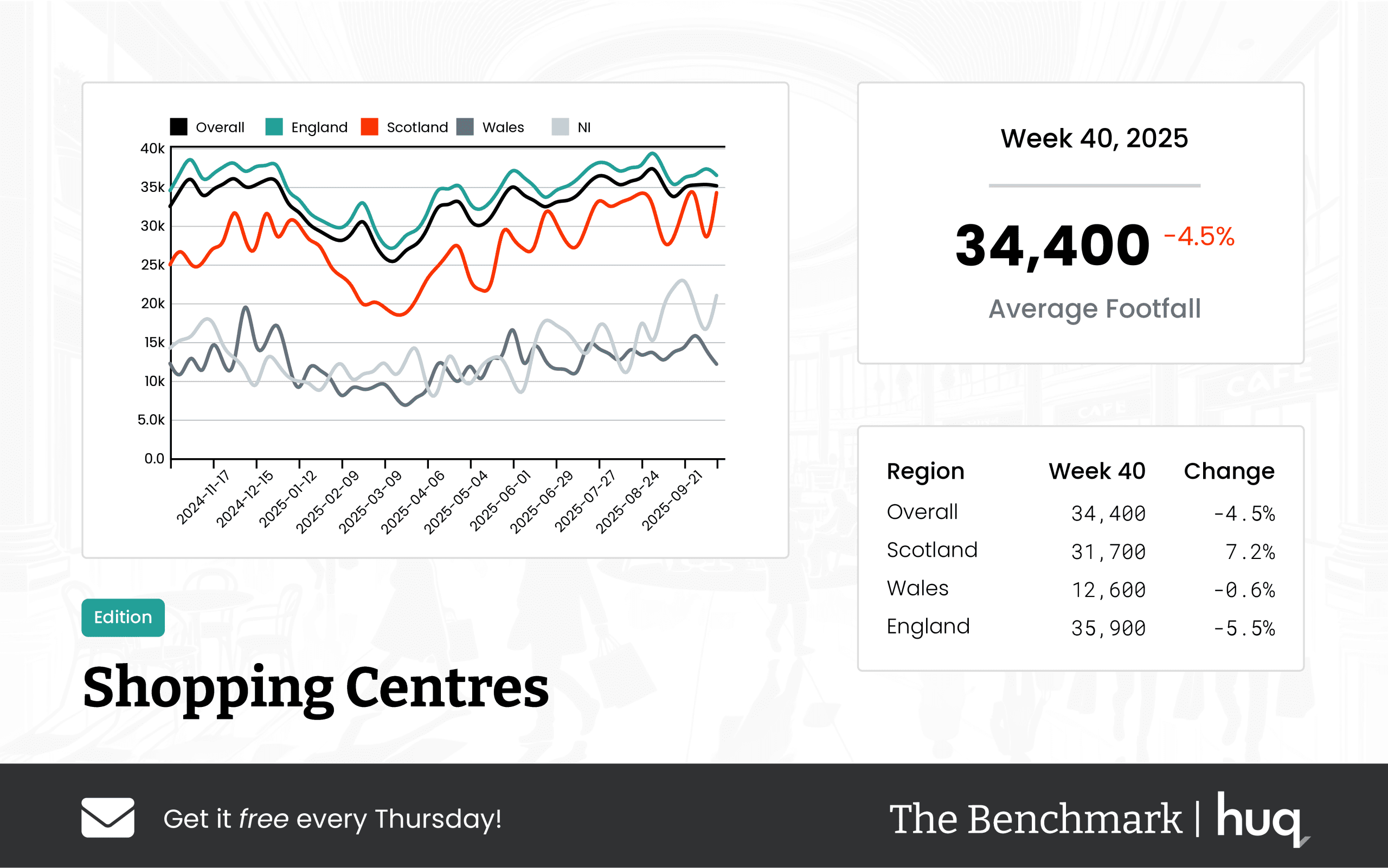
UK Shopping Centres saw a 4.5% drop in footfall this week with overall footfall data indicating a 2.2% annual decline. Footfall analytics suggest evolving consumer habits.
The latest UK Shopping Centres report for Week 40 (2025) highlights notable trends in footfall and consumer behavior. The overall average daily footfall reached 34,400 during the week ending 12 October 2025, reflecting a 4.5% decline on a week-on-week basis and marking a 2.2% drop compared to the previous year. Alongside these figures, the average visit duration has decreased to 101 minutes, showing a recent decline of 2.9% and a 7.3% drop year-on-year.
Regional differences are evident in the data. In Scotland, an average daily footfall of 31,700 was recorded, with a 7.2% increase from the previous week and significant annual gains. This contrasts with England, where footfall averaged 35,900, experiencing both a week-on-week drop of 5.5% and a 4.8% annual decline. In Wales, footfall held at an average daily count of 12,600, with a minimal week-on-week decrease of 0.6% but showing slight positive movement on an annual basis.
Consumer engagement remains a key focus. Visitors in Scotland continued to average 101 minutes per visit, even as recent trends showed a slight softening, while the annual figures suggest a moderate increase in engagement time. England mirrored this pattern with an average visit duration of 102 minutes, experiencing only slight week-on-week fluctuations but a more pronounced annual decrease. Conversely, visitors in Wales, with an average duration of 82 minutes, displayed sharper increases in their engagement time.
Industry reactions have been mixed. Joe Capocci, the spokesperson for Huq Industries, commented, "The latest figures show Scotland’s robust footfall growth alongside subdued trends in England, as supported by retail news of new store openings at Glasgow Silverburn and Manchester Arndale." These developments indicate that while overall trends suggest a cautious market, regional variations continue to drive strategic retail initiatives.
The evolving consumer habits reflected in both footfall and dwell time metrics point to an ongoing transition in retail engagement, with UK shopping centres adapting to new market dynamics amid both challenges and opportunities.
Media: For all media and press enquiries, please contact media@huq.io
About Huq Industries
Huq Industries is the leading provider of location intelligence across the UK, Europe, and the Middle East, specialising in delivering high-quality data insights on footfall, consumer behaviour, and retail performance. By leveraging advanced analytics, Huq Industries enables retailers and analysts to understand and respond to market trends effectively, ensuring they are well-equipped to navigate the changing landscape of high street and town centre commerce.
Get the latest intelligence Benchmark update each Thursday!
Frequently Asked Questions
Clear answers to the most common questions about movement intelligence, retail expansion, and location analytics.
Related Blogs and Insights


.svg)
Empowering strategic teams with the world's most accurate and accessible location intelligence.
Contact

.svg)