.svg)
UK Shopping Centres – Week 21, 2025 Performance Update featuring Location Analytics
UK shopping centres show a steady recovery with overall footfall rising by 9% week-on-week and 6% year-on-year – a trend that aligns with location analytics and location intelligence insights.

June 5, 2025
2 min read
Table of contents
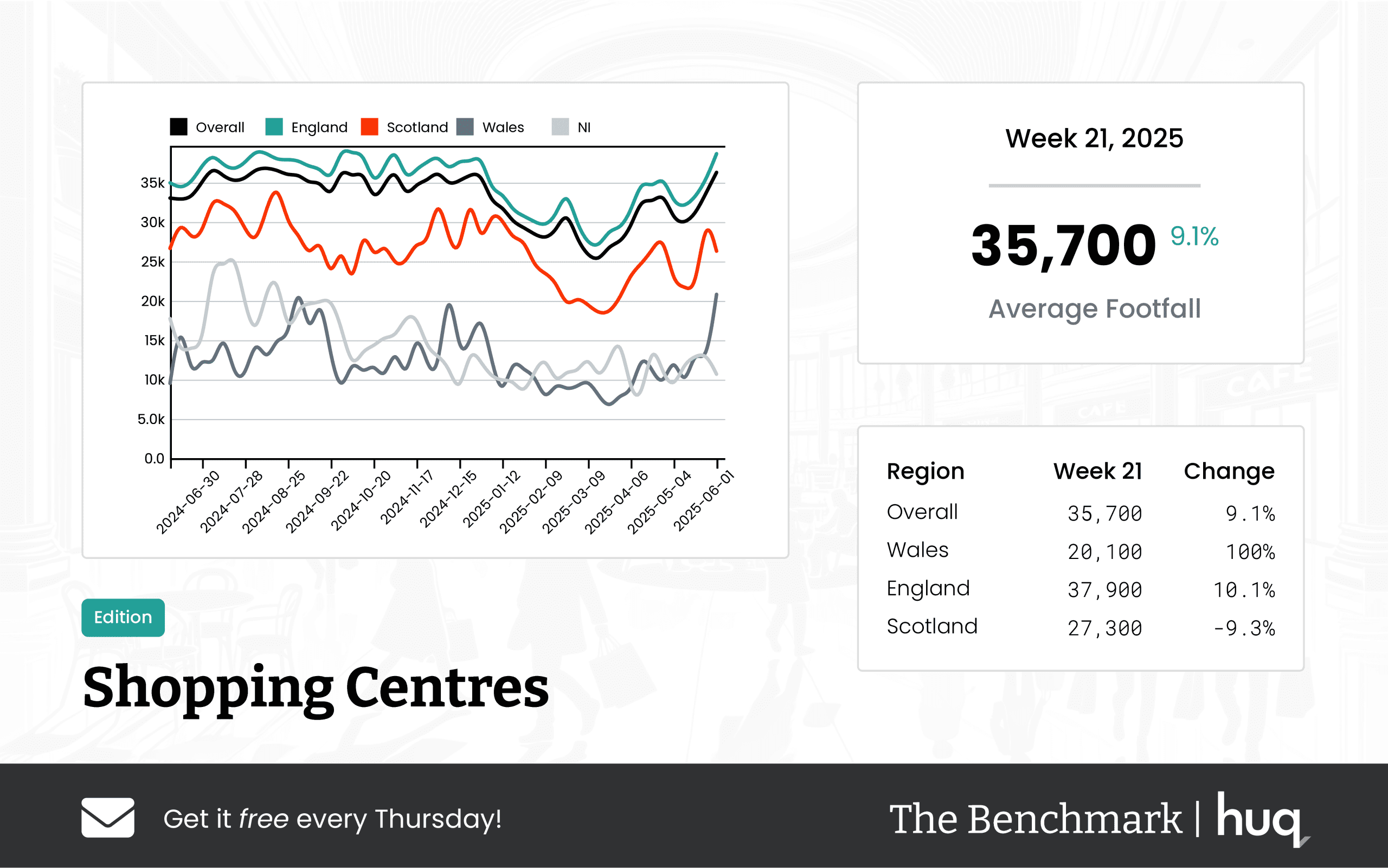
UK shopping centres are reporting a positive rebound with an impressive uptick in both weekly and annual footfall statistics. The latest data for the week ending June 1, 2025, indicates an average daily footfall of 35,700 – a 9.1% increase compared to the previous week and a 6.1% year-on-year rise. This steady growth is lending strong support to the overall optimism in the retail market, a scenario that is being continually refined and confirmed by robust location analytics insights.
Overall Footfall Performance
The report underscores a healthy recovery across the market, with improved visitor trends reaffirming the credibility of location intelligence. These insights are not only optimizing operational strategies for shopping centres but are also providing key demographics and temporal data that guide future investments.
Regional Insights
Diving deeper, the regional performance reveals distinct variations:
• Wales: Centres in Wales recorded an impressive average of 20,100 visitors per day. However, while the week-on-week visitor numbers showed a sharp increase, the average visit duration traditionally reported at 61 minutes experienced a decline, signaling a need for strategies focused on enhancing shopper engagement.
• England: Centres in England are in a phase of stable growth. With an average daily footfall of 37,900 and gains of 10.1% week-on-week and 6.9% year-on-year, the region is demonstrating consistent market performance. The robust average dwell time of 118 minutes serves as an encouraging metric, even in the face of minor short-term softening.
• Scotland: Conversely, Scotland's performance highlighted some challenges. With an average daily footfall of 27,300, the centre's footfall figures have weakened both in the recent week and compared to last year. Moreover, the local dwell time of 90 minutes saw a notable decline during the week, although it shows a modest annual recovery. These insights suggest that targeted tactical interventions may be necessary to reverse the downward trend in visitor engagement.
Industry Comment
Joe Capocci, spokesperson for Huq Industries, commented on the performance update, stating, "The sharp increase in footfall seen in Wales, supported by recent retail industry news, underscores an evolving and resilient market." This comment, together with detailed location intelligence data, reflects the dynamic challenges and opportunities present in the current retail environment.
Conclusion
The UK's retail landscape appears resilient, with shopping centres harnessing the power of advanced location intelligence to drive performance improvements and strategic decisions. As footfall rates and visitor engagement continue to evolve, the application of detailed location analytics is proving indispensable in shaping a more responsive and customer-centric retail environment.
Media: For all media and press enquiries, please contact media@huq.io
About Huq Industries
Huq Industries is the leading provider of location intelligence across the UK, Europe, and the Middle East, specialising in delivering high-quality data insights on footfall, consumer behaviour, and retail performance. By leveraging advanced analytics, Huq Industries enables retailers and analysts to understand and respond to market trends effectively, ensuring they are well-equipped to navigate the changing landscape of high street and town centre commerce.
Get the latest intelligence Benchmark update each Thursday!
Sign Up NowFrequently Asked Questions
Clear answers to the most common questions about movement intelligence, retail expansion, and location analytics.
Related Blogs and Insights


.svg)
Empowering strategic teams with the world's most accurate and accessible location intelligence.
Contact

.svg)