.svg)
UK Retail Parks – Week 9 2025 Footfall Performance Update
UK retail parks see a modest 3% drop in average daily footfall, with visitors spending 1.4% more time on site. footfall retail trends indicate improved quality of visit.

March 13, 2025
2 min read
Table of contents
UK retail parks see a modest 3% drop in average daily footfall, with visitors spending 1.4% more time on site. footfall retail trends indicate improved quality of visit.
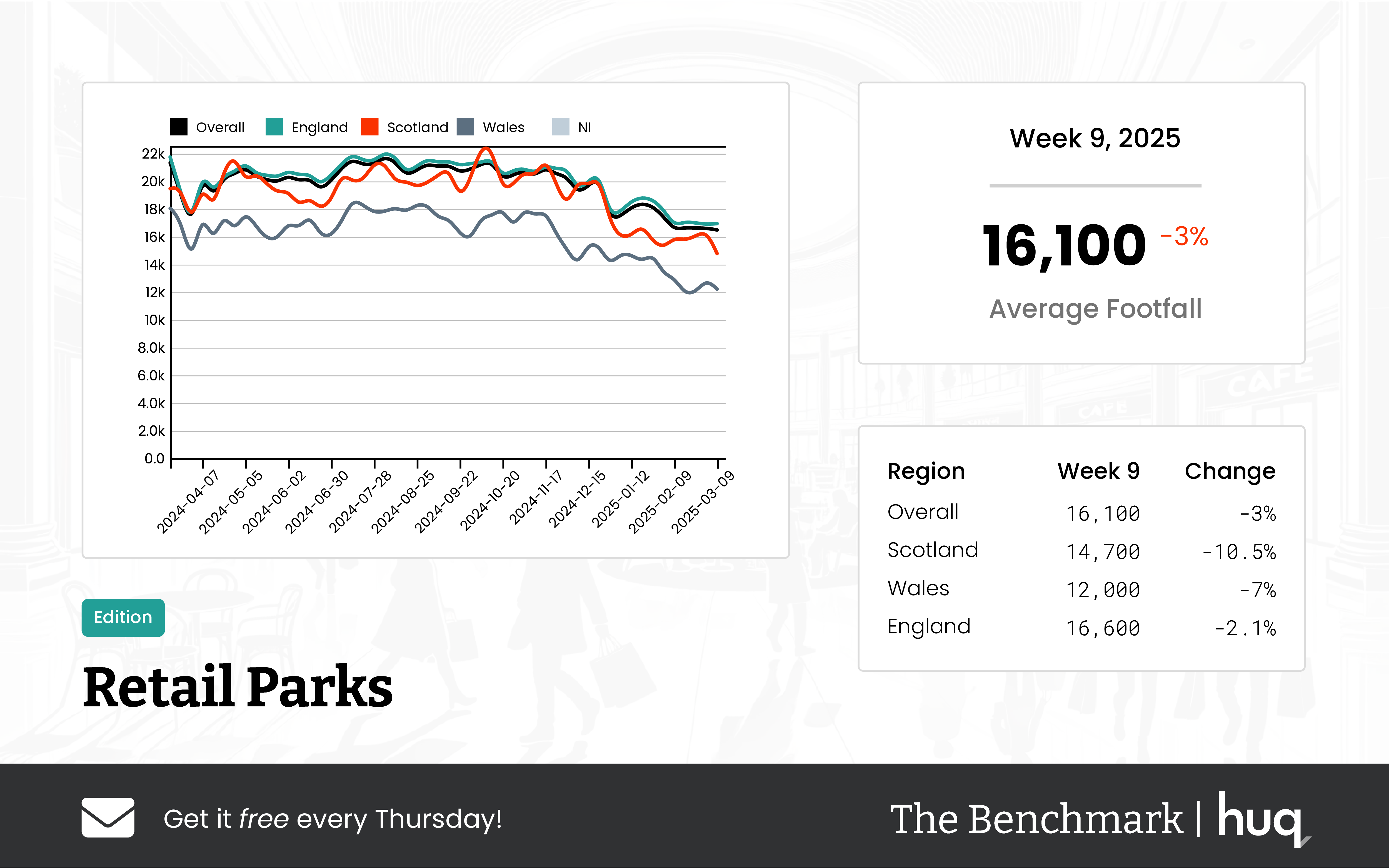
Huq Industries' latest data reveals that UK retail parks experienced a slight overall drop in average daily footfall to 16,100 visitors, marking a 3% week-on-week decrease and a 19.1% decline year-on-year. Despite the reduced traffic, the data shows a positive trend: shoppers now spend more time at the parks, with the average visit duration rising to 74 minutes—a week-on-week gain of 1.4% and a 15.6% improvement from the same period last year.
A deeper look into regional performance shows notable variations. England's retail parks recorded an average of 16,600 visitors daily, with only a minor 2.1% week-on-week drop and an 18% year-on-year decline, suggesting some resilience. Scotland, on the other hand, saw a lower average of 14,700 visitors and a more significant 10.5% drop over the week, accompanied by a notable annual decline. Wales recorded the lowest daily average at 12,000 visitors, along with a 7% weekly fall and a similar year-on-year decrease.
Dwell time trends suggest evolving consumer behavior, as shoppers are spending more time at retail parks. In Scotland, visitors now stay for an average of 81 minutes—an 8% week-on-week increase—while England and Wales report average visit durations of 73 and 66 minutes, respectively. This increased dwell time may be offsetting the decline in footfall by offering a better quality of visit, hinting at a shift from quantity to quality within the retail park experience.
Joe Capocci, Huq Industries Spokesperson, commented on these findings, stating, "Overall, the current trends suggest that while fewer consumers may be visiting, those who do are engaging more deeply, potentially paving the way for a reimagined retail experience in the UK."
Media: For all media and press enquiries, please contact media@huq.io
About Huq Industries
Huq Industries is the leading provider of location intelligence across the UK, Europe, and the Middle East, specialising in delivering high-quality data insights on footfall, consumer behaviour, and retail performance. By leveraging advanced analytics, Huq Industries enables retailers and analysts to understand and respond to market trends effectively, ensuring they are well-equipped to navigate the changing landscape of high street and town centre commerce.
Get the latest intelligence Benchmark update each Thursday!
Frequently Asked Questions
Clear answers to the most common questions about movement intelligence, retail expansion, and location analytics.
Related Blogs and Insights



.svg)
Empowering strategic teams with the world's most accurate and accessible location intelligence.
Contact

.svg)