.svg)
UK Retail Parks – Week 8 Performance Update 2025: Insights from location analytics
UK Retail Parks show a modest weekly increase (0.6%) but a yearly decline (16.5%). Dwell time improved by 14.1%, with shifts in footfall observed via location analytics.

March 6, 2025
2 min read
Table of contents
UK Retail Parks show a modest weekly increase (0.6%) but a yearly decline (16.5%). Dwell time improved by 14.1%, with shifts in footfall observed via location analytics.
Overall Performance
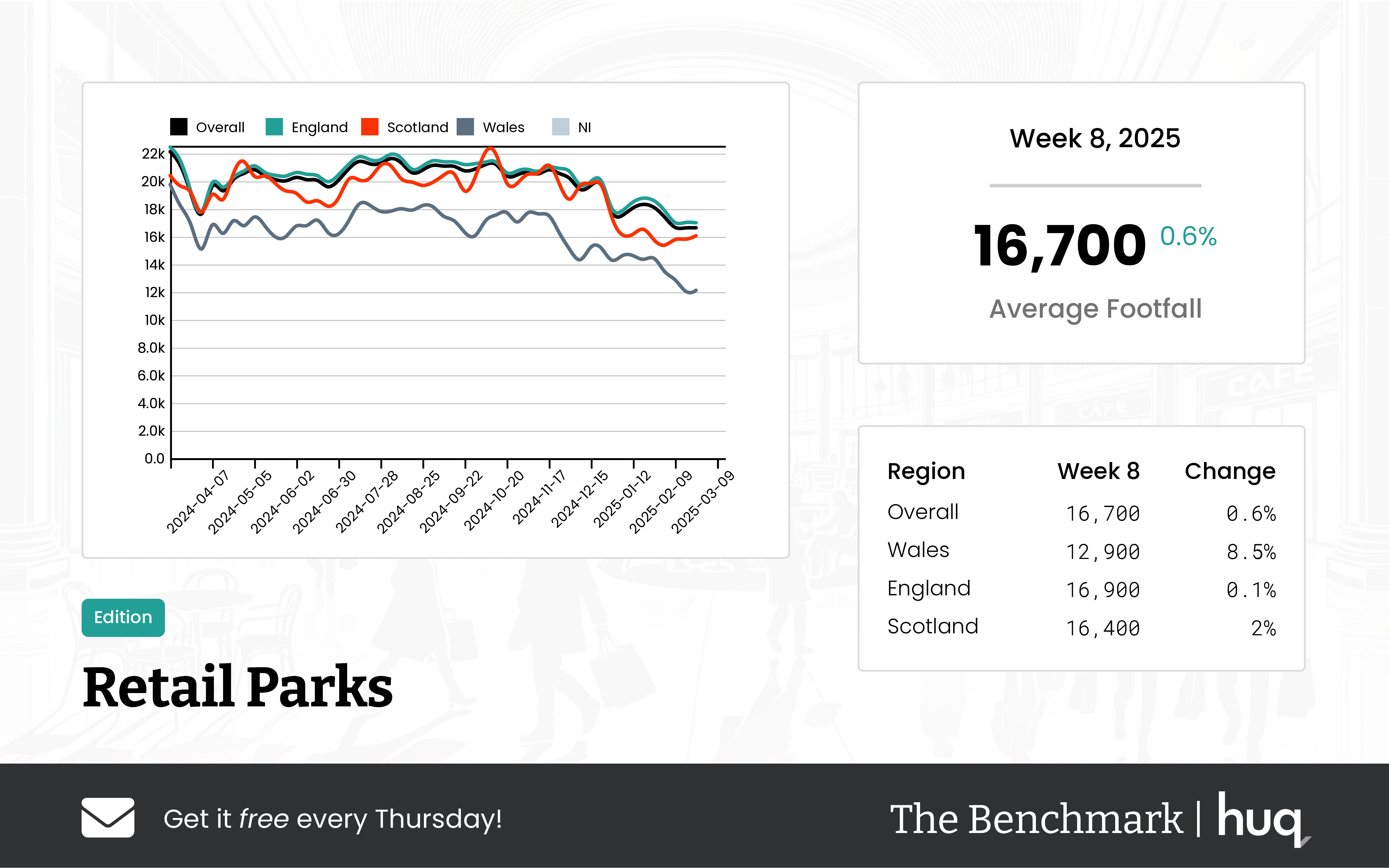
Recent data for UK retail parks indicate that, for the period ending 2025-03-02, locations across the country averaged 16,700 daily visits. Using location analytics, our analysis shows that consumer behaviour is shifting, with daily visits and footfall being closely monitored. The week on week change was modest at 0.6%, whereas the year on year performance shows a decline of 16.5%, reflecting ongoing challenges in the longer term.
Dwell time averaged 73 minutes per visit, with a weekly increase of 2.8% and an annual improvement of 14.1%, suggesting that visitors are spending more time at retail parks despite lower overall footfall.
Regional Breakdown
In England, retail parks recorded an average of 16,900 visits per day. The week on week change was minimal at 0.1%, with a year on year figure reflecting a decline of 16.2%. Visitors in England spent around 72 minutes per visit, experiencing a modest weekly gain of 1.4% and a year on year increase of 9.1%.
Scottish retail parks experienced an average of 16,400 visits, with a 2% weekly increase and a year on year decline of 14.2%. The average dwell time in Scotland was the highest overall at 75 minutes, showing weekly growth and a notable annual improvement.
Wales presents a different profile, where despite achieving an average of 12,900 daily visits and the strongest week on week gain of 8.5%, the year on year performance still reflects a notable decline. Dwell time in Wales averaged 71 minutes with modest weekly progress and a sharp increase on an annual basis.
Comment
Joe Capocci, Huq Industries Spokesperson, stated, "The noticeable weekly improvement in Wales, alongside recent retail industry updates on park developments, underscores a subtle shift in consumer behaviour that retailers must carefully monitor."
Media: For all media and press enquiries, please contact media@huq.io
About Huq Industries
Huq Industries is the leading provider of location intelligence across the UK, Europe, and the Middle East, specialising in delivering high-quality data insights on footfall, consumer behaviour, and retail performance. By leveraging advanced analytics, Huq Industries enables retailers and analysts to understand and respond to market trends effectively, ensuring they are well-equipped to navigate the changing landscape of high street and town centre commerce.
Get the latest intelligence Benchmark update each Thursday!
Frequently Asked Questions
Clear answers to the most common questions about movement intelligence, retail expansion, and location analytics.
Related Blogs and Insights



.svg)
Empowering strategic teams with the world's most accurate and accessible location intelligence.
Contact

.svg)