.svg)
UK Retail Parks – Week 38 Performance Update 2025: Footfall Data Trends
The latest UK Retail Parks footfall data shows a moderate uplift with 20,400 daily visitors, while robust trends in footfall analytics hint at steady overall performance.

October 2, 2025
2 min read
Table of contents
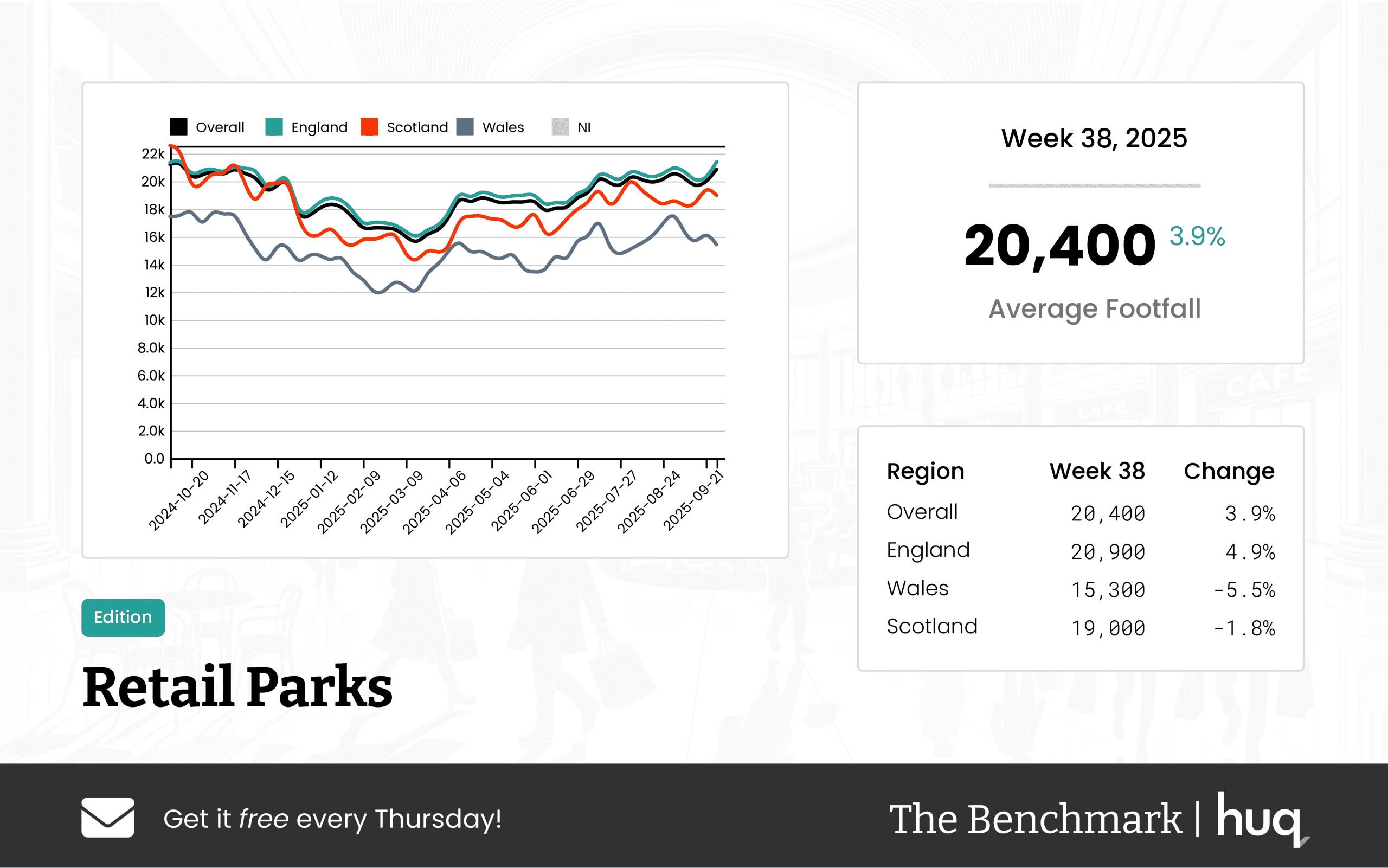
The most recent data from The Benchmark reveals that UK Retail Parks achieved an average daily footfall of 20,400 for the week ending September 28, 2025. Although this is a modest week‑on‑week increase, it comes with a slight softness when benchmarked against the same period last year. The data underscores the continued relevance of footfall analytics in understanding retail performance, highlighting steady momentum alongside longer‑term growth challenges.
Key regional insights include:
• England leads the pack with Retail Parks drawing an average of 20,900 daily visitors. Despite only slight softening versus historical data, the steady increase across the week indicates robust market performance.
• Wales, on the other hand, recorded a daily average of 15,300 visitors and experienced a weekly drop. Year‑on‑year comparisons suggest that many Welsh Retail Parks are struggling to sustain visitor numbers.
• Scotland's Retail Parks recorded an average of 19,000 daily visitors, with a slight downturn on a weekly basis and softer visitation figures in comparison to the previous year.
Visitor engagement metrics also provide noteworthy insight. Across the UK, average dwell time was recorded at 78 minutes per visit. While there was a slight decrease in dwell time over the week, the encouraging year‑on‑year improvement indicates that, despite fewer overall visitors, the duration of visits is increasing. England, in particular, leads in visitor engagement with an average dwell time of 81 minutes, whereas both Wales and Scotland have seen declines in this metric, further emphasizing regional disparities.
Joe Capocci, spokesperson for Huq Industries, observed, "The most striking change in our data is the pronounced drop in Welsh footfall, a trend subtly supported by recent Retail Industry News regarding new store openings."
The insights drawn from these footfall statistics underline both the strengths and challenges faced by the retail park sector, as operators continue to navigate a complex landscape marked by localized shifts and broader economic trends.
Media: For all media and press enquiries, please contact media@huq.io
About Huq Industries
Huq Industries is the leading provider of location intelligence across the UK, Europe, and the Middle East, specialising in delivering high-quality data insights on footfall, consumer behaviour, and retail performance. By leveraging advanced analytics, Huq Industries enables retailers and analysts to understand and respond to market trends effectively, ensuring they are well-equipped to navigate the changing landscape of high street and town centre commerce.
Get the latest intelligence Benchmark update each Thursday!
Frequently Asked Questions
Clear answers to the most common questions about movement intelligence, retail expansion, and location analytics.
Related Blogs and Insights



.svg)
Empowering strategic teams with the world's most accurate and accessible location intelligence.
Contact

.svg)