.svg)
UK Local Retail Centres – Week 36, 2025 Update: Location Analytics Reveals Trends
UK Local Retail Centres show a moderate recovery with a daily footfall of 16,300. Analysis across England, Scotland, and Wales reveals regional nuances in footfall and dwell time, highlighting both short-term uplifting trends and ongoing year‑on‑year declines.

September 19, 2025
2 min read
Table of contents
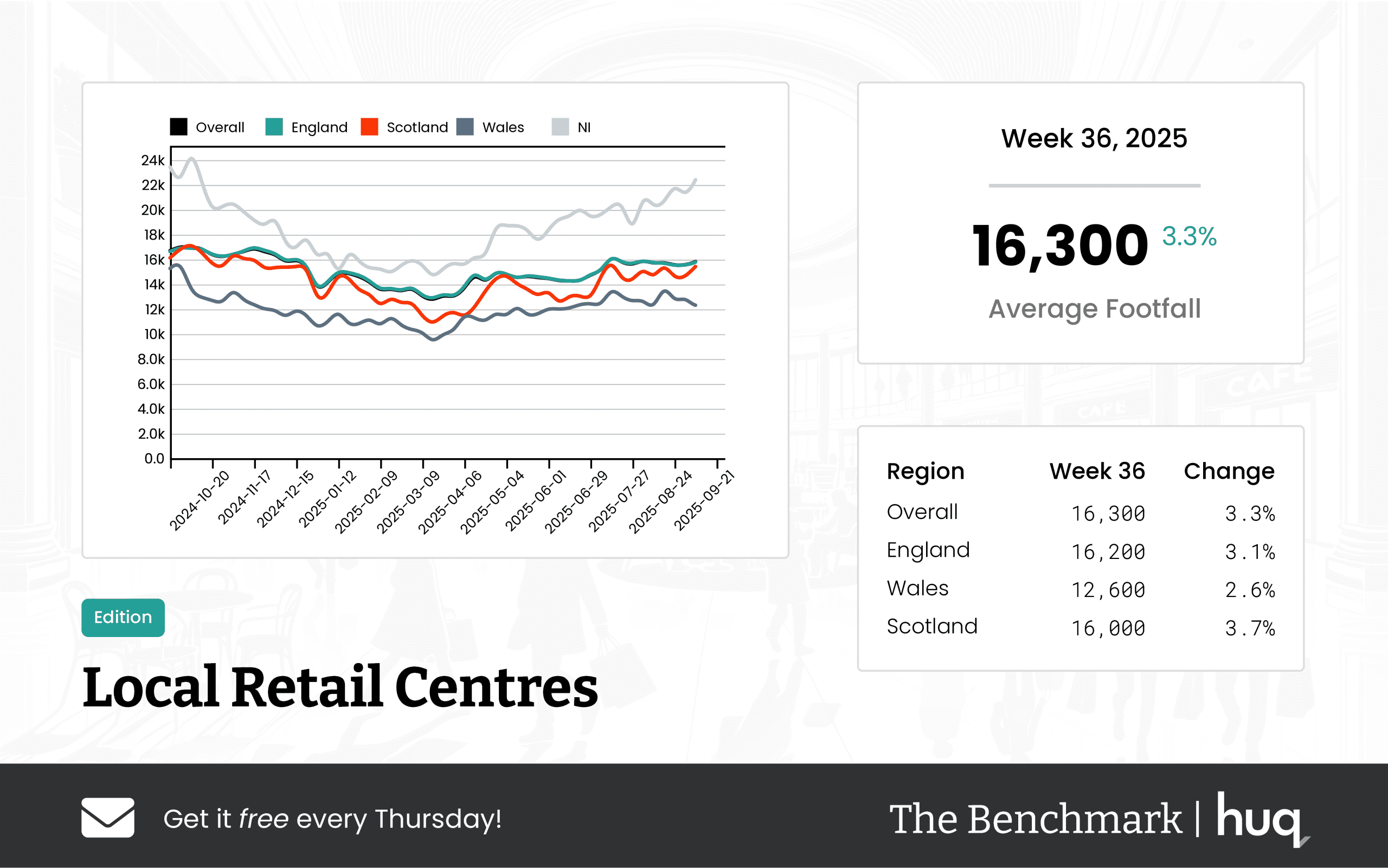
The latest weekly update on UK Local Retail Centres paints a picture of a cautious yet promising recovery as location analytics report an overall average daily footfall of 16,300. Although year‑on‑year figures show a decline, week‑on‑week improvements suggest that certain markets are beginning to bounce back.
A closer inspection reveals distinct regional dynamics. In England, retail centres achieved an average daily footfall of 16,200. Despite a modest increase in recent footfall, long‑term trends indicate a slight decline, underscoring the delicate balance between short-term recovery and persistent challenges.
Scotland shows an interesting trend with an average daily footfall of 16,000 – coupled with a sharper week‑on‑week increase. Yet, the annual figures indicate that Scotland is not immune to the broader retail challenges, showing a more noticeable long-term decline compared to its transient weekly gains.
Wales reflects a divergent scenario with a lower average daily footfall of just 12,600. Even though the week‑on‑week trend is positive, the year‑on‑year data displays a more significant decline. This drop in footfall points toward tougher conditions in Wales, sparking a call for tailored strategies to revitalize the retail environment.
Visitor dwell time provides further insights into consumer behavior. Across all centres, visitors are spending an average of 101 minutes per visit, a duration that has benefited from a week‑on‑week uplift and an encouraging annual increase. England’s visitors clock in slightly above average at 102 minutes, experiencing both recent gains and healthy annual improvements.
Scotland remains a standout, boasting an impressive average visit time of 109 minutes, reflective of a striking week‑on‑week boost and positive momentum over the longer term. In contrast, Welsh retail centres see visitors spending only 94 minutes on average, with recent figures showing a noticeable decline that echoes the broader annual softness.
Industry experts are keeping a close watch on these trends. Joe Capocci, a spokesperson for Huq Industries, remarked, "These figures, highlighted by a sharp increase in Scotland's footfall and supported by recent retail industry news, provide a clear insight into the nuanced recovery trends across our markets." His comments underscore the importance of adapting strategies to the varied regional dynamics in the UK's retail landscape.
As the market evolves, the careful interpretation of both short‑term and long‑term data remains crucial. The trends indicate that while there are signs of recovery, challenges persist across the board, calling for a measured and regionally tailored approach to revitalize local retail centres.
Media: For all media and press enquiries, please contact media@huq.io
About Huq Industries
Huq Industries is the leading provider of location intelligence across the UK, Europe, and the Middle East, specialising in delivering high-quality data insights on footfall, consumer behaviour, and retail performance. By leveraging advanced analytics, Huq Industries enables retailers and analysts to understand and respond to market trends effectively, ensuring they are well-equipped to navigate the changing landscape of high street and town centre commerce.
Get the latest intelligence Benchmark update each Thursday!
Frequently Asked Questions
Clear answers to the most common questions about movement intelligence, retail expansion, and location analytics.
Related Blogs and Insights


.svg)
Empowering strategic teams with the world's most accurate and accessible location intelligence.
Contact

.svg)