.svg)
UK Local Retail Centres – Week 32 (2025) Footfall Retail Update
UK Local Retail Centres saw steady growth in week 32, 2025 with a 2.5% rise in average daily footfall of 16,000. Recent footfall data confirms the overall positive trend.

August 21, 2025
2 min read
Table of contents
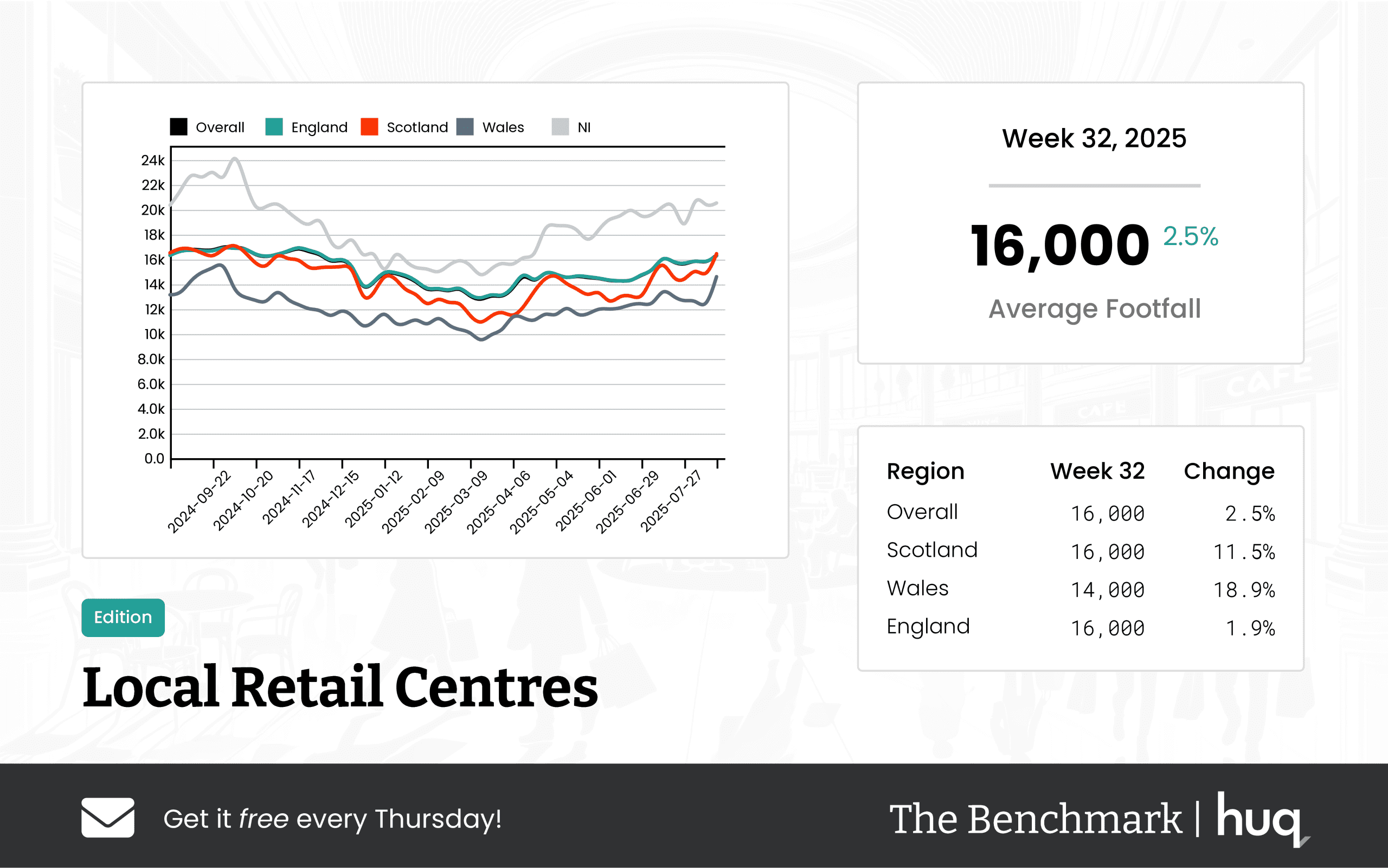
UK Local Retail Centres delivered strong performance during week 32 of 2025. The centres reached an average daily footfall of 16,000, marking a 2.5% increase from the previous week. Although the year-on-year growth remained marginal at 0.1%, the figures indicate a stable and consistent visitor trend across the sector.
Overall Footfall Performance
The recent data for the week ending 17 August 2025 showed that, despite only minor annual changes, there is a clear indication of gradual growth in visitor numbers. The continued stability and slight uplift in weekly footfall reaffirm the positive outlook for local retail centres.
Regional Comparisons
Differences in performance across regions were notable. In Wales, centres reported an average daily footfall of 14,000, accompanied by an impressive 18.9% week-on-week rise and a 10.3% annual increase. Scotland's centres, however, maintained the overall average of 16,000 with an 11.5% week-on-week boost, but experienced a slight year-on-year decline of 1.1%, suggesting that while the immediate results are strong, longer-term growth may be more challenging.
Visitor Engagement
Dwell time remains a critical metric for assessing visitor engagement. Across all centres, the average visit duration was 93 minutes. Although this represented a small 1.1% decline from the previous week, there was a notable annual improvement of 9.4%. Wales again outperformed, with visitors spending an average of 119 minutes per visit, compared to 89 minutes in Scotland and 94 minutes in England. These trends underscore a quality visitor experience despite varying regional metrics.
Industry Comment
Joe Capocci, a spokesperson for Huq Industries, remarked on the latest trends: "The sharp increase in Wales and recent retail developments such as the new IKEA Brighton opening underline the evolving consumer trends seen in our latest results." His comment highlights how emerging retail developments are contributing to dynamic shifts in consumer behavior across different regions.
Media: For all media and press enquiries, please contact media@huq.io
Frequently Asked Questions
Clear answers to the most common questions about movement intelligence, retail expansion, and location analytics.
Related Blogs and Insights


.svg)
Empowering strategic teams with the world's most accurate and accessible location intelligence.
Contact

.svg)