.svg)
UK Local Retail Centres – Week 19, 2025: Location Analytics Update
UK Local Retail Centres saw a gradual recovery in Week 19 with footfall up 3.1% weekly and a 0.8% annual rise, demonstrating robust location analytics and evolving location intelligence trends.

May 22, 2025
2 min read
Table of contents
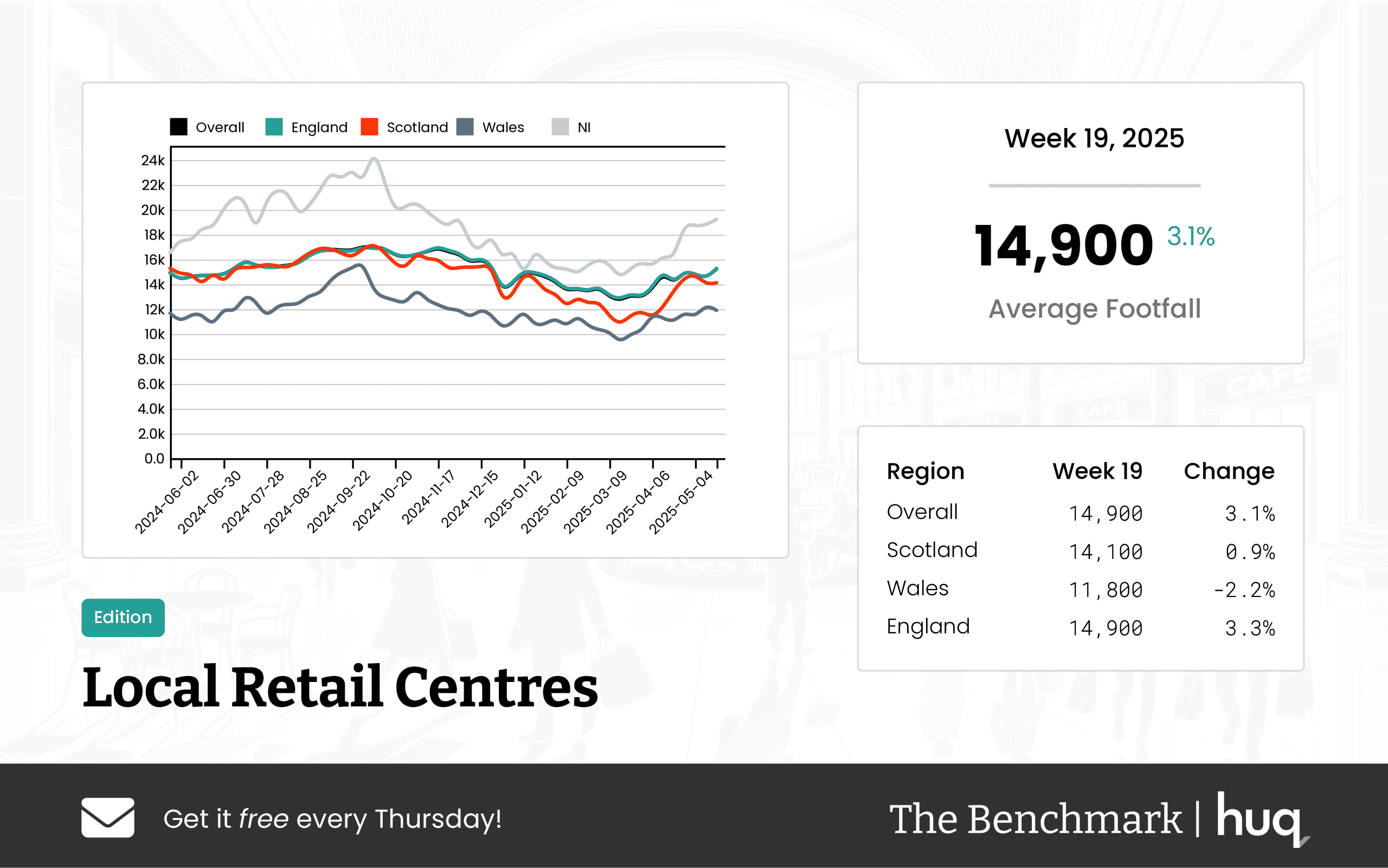
The latest figures from The Benchmark provide an update on footfall and dwell time performance across UK Local Retail Centres for Week 19. Incorporating location analytics into performance reviews has become essential. Overall, centres recorded an average daily footfall of 14,900, marking a 3.1% week-on-week improvement and a modest year-on-year increase of 0.8%. This gradual upward trend indicates that visitor numbers continue to slowly strengthen across the retail landscape.
Regional Performance
Examining regional performance reveals some variation. In England, centres maintained an average of 14,900 daily visitors with a week-on-week lift of 3.3% and an annual increase of 1.1%, suggesting that recent visits are slightly stronger relative to historical performance. Meanwhile, in Scotland, the average daily footfall stands at 14,100. Although there is a 0.9% weekly gain, the centres have experienced a year-over-year decline, reflecting a retreat compared to previous years despite emerging short-term recovery. In Wales, the situation is somewhat different; centres attract an average of 11,800 daily visitors, but figures show a 2.2% decrease on a weekly basis while the year-on-year change remains nearly static at 0.1%. This stability over the longer term contrasts with the recent drop in visitor numbers.
Dwell Time Update
Dwell time data paints a complementary picture. Across the UK, the average visit now lasts 100 minutes, registering a modest 1% increase from the previous week and a 19% annual boost. Scottish centres lead with an average dwell time of 110 minutes, even though there has been some recent softening, while Welsh centres report the lowest average at 86 minutes with recent declines noted in the data.
Industry experts highlight that emerging location intelligence trends are beginning to shape footfall metrics. Recent investments underscore the importance of location intelligence in driving regional performance, and analysts observe that a focus on location intelligence may support ongoing retail recovery. Continued monitoring reveals that advances in location intelligence are influencing centre strategies.
Joe Capocci, a spokesperson for Huq Industries, stated, "The strongest footfall improvement in England, observed alongside new retail expansion plans as reported in recent industry news, reflects the evolving dynamics of our retail environment."
Media: For all media and press enquiries, please contact media@huq.ioAbout Huq Industries
Huq Industries is the leading provider of location intelligence across the UK, Europe, and the Middle East, specialising in delivering high-quality data insights on footfall, consumer behaviour, and retail performance. By leveraging advanced analytics, Huq Industries enables retailers and analysts to understand and respond to market trends effectively, ensuring they are well-equipped to navigate the changing landscape of high street and town centre commerce.
Frequently Asked Questions
Clear answers to the most common questions about movement intelligence, retail expansion, and location analytics.
Related Blogs and Insights


.svg)
Empowering strategic teams with the world's most accurate and accessible location intelligence.
Contact

.svg)