.svg)
UK High Streets & Town Centres – Week 41 2025: Footfall Update
Overall week-on-week footfall dropped 3.3% while year-on-year improvements persist. Recent footfall analytics show a positive annual trend amid modest declines.

October 23, 2025
1 min read
Table of contents
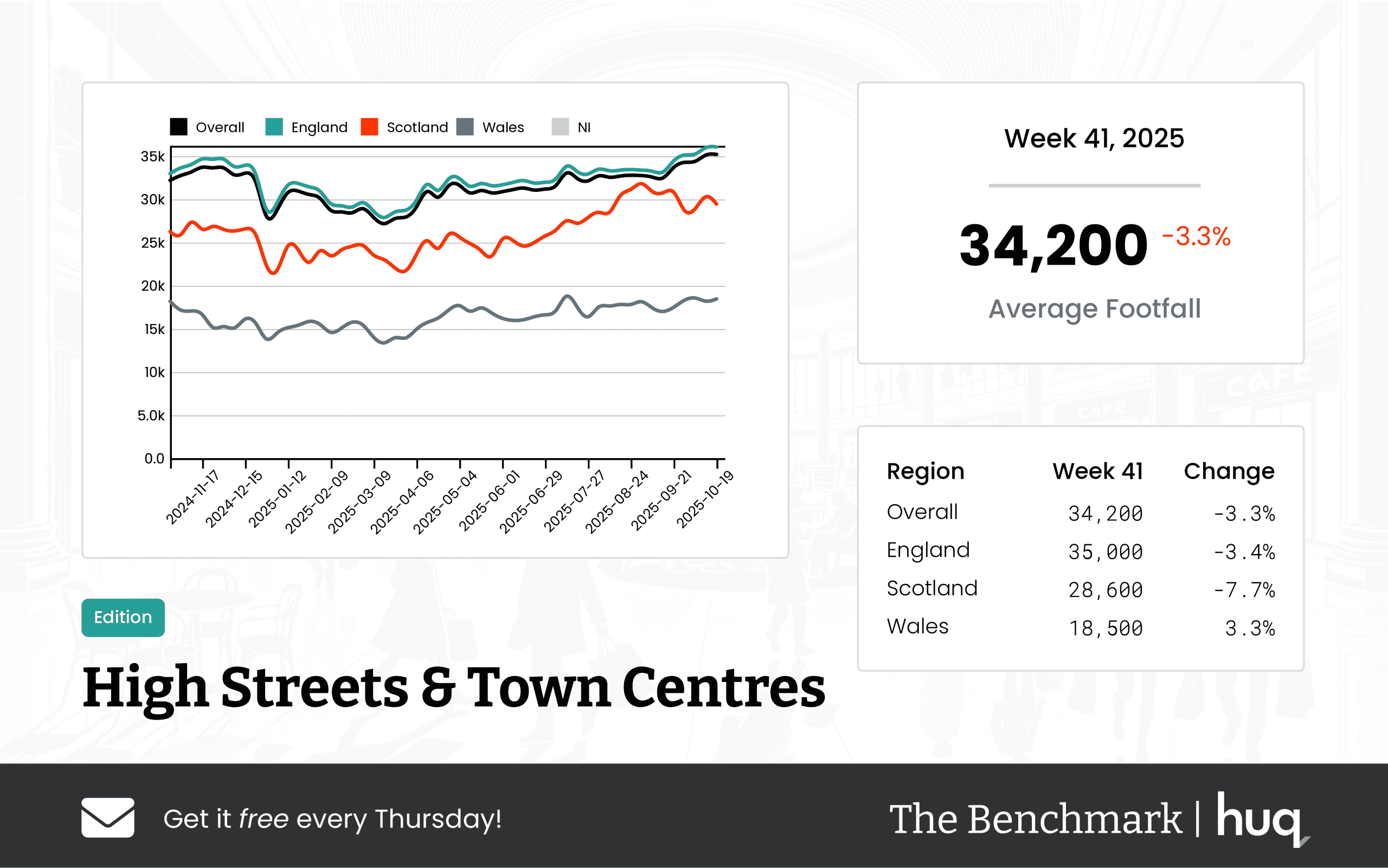
The latest analysis of UK High Streets and Town Centres has revealed a mixed picture for the week ending 19 October 2025. Average daily footfall across these key locations stands at 34,200, marking a week-on-week decline of 3.3%, even as annual comparisons point to a steady upward trajectory.
In England, High Streets and Town Centres reported an average daily footfall of 35,000 with a modest weekly slowdown of 3.4%, while still registering improvements on an annual basis. Scotland's High Streets and Town Centres saw an average of 28,600 visitors per day, experiencing a more pronounced weekly decline, yet the long-term annual trend remains positive. Contrastingly, Wales experienced a slight week-on-week gain with an average daily footfall of 18,500.
Dwell time data further deepens the analysis. On average, visitors spent 106 minutes in these locations, though regional variances emerged. England maintained the overall average, Scotland's visitors spent 78 minutes, and those in Wales lingered for 117 minutes, indicating a higher level of engagement.
Joe Capocci, spokesperson for Huq Industries, summed up the results: "The data clearly shows Scotland's more pronounced week-on-week decline in footfall alongside a modest uplift in Wales, which is consistent with recent retail industry observations in Time Out and The Herald."
Media: For all media and press enquiries, please contact media@huq.io
About Huq Industries
Huq Industries is the leading provider of location intelligence across the UK, Europe, and the Middle East, specialising in delivering high-quality data insights on footfall, consumer behaviour, and retail performance. By leveraging advanced analytics, Huq Industries enables retailers and analysts to understand and respond to market trends effectively, ensuring they are well-equipped to navigate the changing landscape of high street and town centre commerce.
Get the latest intelligence Benchmark update each Thursday!
Frequently Asked Questions
Clear answers to the most common questions about movement intelligence, retail expansion, and location analytics.
Related Blogs and Insights


.svg)
Empowering strategic teams with the world's most accurate and accessible location intelligence.
Contact

.svg)