.svg)
UK High Streets & Town Centres – Week 35, 2025: A Location Analytics Update
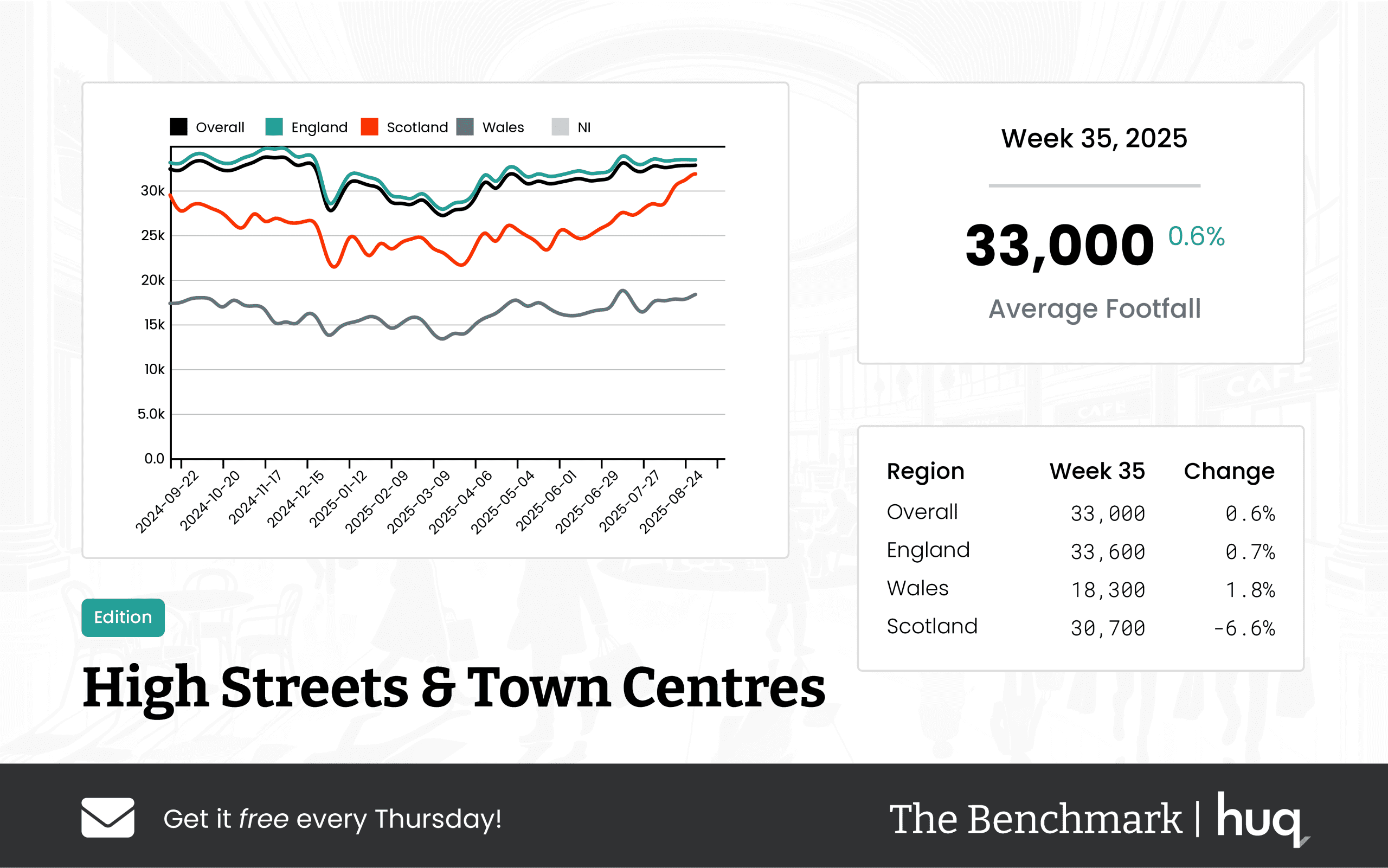
Week 35 data shows modest gains on UK high streets & town centres with a 0.6% week-on-week and 2.4% year-on-year rise. Trending location analytics and location intelligence highlight the gradual recovery.

September 12, 2025
2 min read
Table of contents
Overview
The latest Benchmark report for the week ending September 7, 2025, has revealed a modest uptick in visitor numbers across UK high streets and town centres. The overall average daily footfall reached 33,000—a 0.6% increase from the previous week and a 2.4% boost compared to the same period last year—further underlining the gradual recovery in consumer engagement. Additionally, the average visit duration climbed to 103 minutes, marking a 4% increase over the previous week and a 13.2% rise on a year-on-year basis. The data provides vital insights into evolving consumer trends, showcasing the role of location analytics and location intelligence in this recovery phase.
Regional Analysis
In England, the daily footfall averaged 33,600, reflecting a 0.7% week-on-week increase and a 1.9% year-on-year uplift, which is indicative of a steady rebound in consumer activity. Wales experienced a pronounced week-on-week rise of 1.8% in daily average footfall, reaching 18,300, with an impressive annual increase of 6.2%—although the average visit duration was slightly lower at 87 minutes. In contrast, while Scotland’s annual footfall surged by 10.4% to average 30,700 visitors, it faced a sharp weekly decline of 6.6% and an average visit duration of 90 minutes. These regional insights highlight how location intelligence provides businesses with key actionable information to understand shifting consumer dynamics.
Industry Comment
The report has sparked commentary from industry experts, who note the growing importance of location intelligence in tracking consumer patterns and refining operational strategies. Joe Capocci from Huq Industries remarked, "The sharp weekly decline in Scotland’s footfall alongside a modest recovery in Wales, as reflected in recent Retail Industry News, highlights the need for retailers to adapt to evolving visitor behaviours." The findings underscore the continued reliance on location analytics to decipher nuanced trends that can shape future strategies in the retail sector.
Media: For all media and press enquiries, please contact media@huq.io
About Huq Industries
Huq Industries is the leading provider of location intelligence across the UK, Europe, and the Middle East, specialising in delivering high-quality data insights on footfall, consumer behaviour, and retail performance. By leveraging advanced analytics, Huq Industries enables retailers and analysts to understand and respond to market trends effectively, ensuring they are well-equipped to navigate the changing landscape of high street and town centre commerce.
Get the latest intelligence Benchmark update each Thursday!
Frequently Asked Questions
Clear answers to the most common questions about movement intelligence, retail expansion, and location analytics.
Related Blogs and Insights


.svg)
Empowering strategic teams with the world's most accurate and accessible location intelligence.
Contact

.svg)