.svg)
UK High Streets & Town Centres – Week 11, 2025: Footfall Retail Trends
Cautious recovery as footfall data shows a 5.3% weekly rise and a 1.7% annual drop, reflecting steady footfall analytics in UK retail centres.

March 26, 2025
2 min read
Table of contents
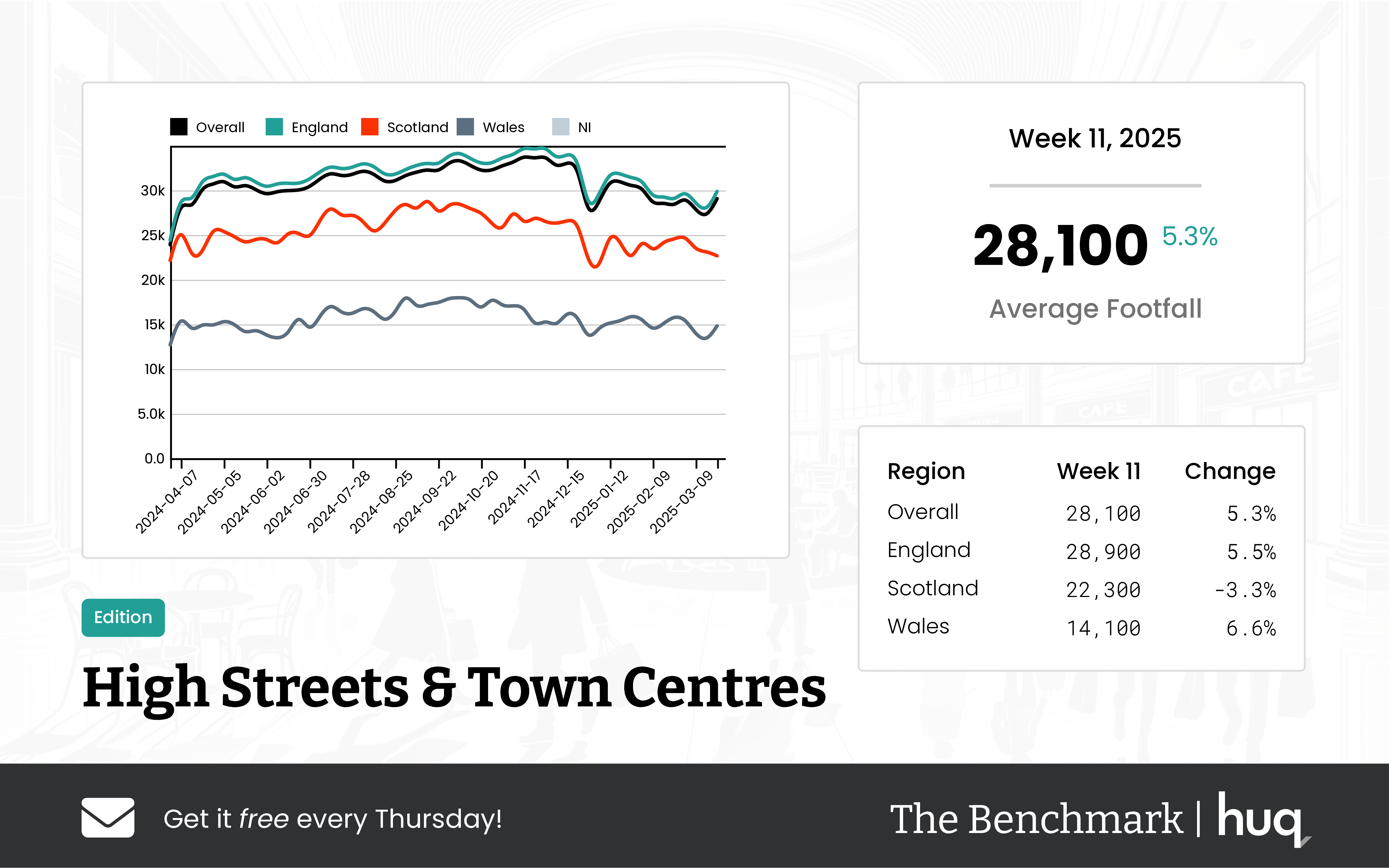
UK high streets and town centres are seeing cautious signs of recovery. The most recent figures from The Benchmark show an overall average daily footfall of 28,100 in the latest week, reflecting a 5.3% increase on a week-on-week basis, even though there is a 1.7% decrease compared to the same week last year. This mixed trend highlights a resilient yet stabilizing market, where short-term upticks contrast with slightly weaker long-term performance.
In England, the picture looks fairly positive with an average of 28,900 daily visitors, a 5.5% week-on-week increase, and only a minimal 0.9% year-on-year decline. This suggests that although the market has its challenges, recent recovery efforts seem to be paying off.
The situation in Scotland tells a different story. Here, high streets and town centres averaged just 22,300 daily visitors. This is coupled with a 3.3% reduction over the week and a significant year-on-year decline of 15.9%, pointing to more turbulent times in that region.
Wales has also recorded notable shifts, with an average of 14,100 daily visitors. The week-on-week performance was promising with a 6.6% increase, but the year-on-year comparison shows an 18.3% decline, painting a picture of a market under stress despite short-term gains.
Dwell time measurements, which provide insights into visit quality, remained steady overall at an average of 96 minutes per visit for the latest week. While this duration is consistent with the previous week's data, it represents an 18.5% improvement compared to last year. In England, dwell time trends closely mirror these overall patterns.
Scotland's visitors spent slightly more time on average, clocking in at 100 minutes per visit. Despite a week-on-week dip of 5.7% in dwell time, there has been a marked increase over a longer period. Wales again presents a mixed scenario: although the average visit duration remained at 96 minutes, there was a notable week-on-week decline of 15%, even as the year-on-year figure shows a moderate recovery of 14.3%.
Joe Capocci, spokesperson for Huq Industries, summed up the situation by highlighting the profound challenges facing the industry, especially in Wales: "The most striking change in our results is the notable decline in footfall across Wales, and recent industry news further underscores the importance of monitoring these trends."
Media: For all media and press enquiries, please contact media@huq.io
About Huq Industries
Huq Industries is the leading provider of location intelligence across the UK, Europe, and the Middle East, specialising in delivering high-quality data insights on footfall, consumer behaviour, and retail performance. By leveraging advanced analytics, Huq Industries enables retailers and analysts to understand and respond to market trends effectively, ensuring they are well-equipped to navigate the changing landscape of high street and town centre commerce.
Get the latest intelligence Benchmark update each Thursday!
Sign Up NowFrequently Asked Questions
Clear answers to the most common questions about movement intelligence, retail expansion, and location analytics.
Related Blogs and Insights


.svg)
Empowering strategic teams with the world's most accurate and accessible location intelligence.
Contact

.svg)