.svg)
Week 7, 2025 UK Shopping Centres Performance – A Deep Dive with Location Analytics
UK Shopping Centres' Location Analytics show a week‑on‑week uplift and modest year‑on‑year gains, drawing an average of 32,200 daily visitors.

February 27, 2025
3 min read
Table of contents

UK Shopping Centres' Location Analytics show a week‑on‑week uplift and modest year‑on‑year gains, drawing 32,200 daily visitors.
Performance Overview
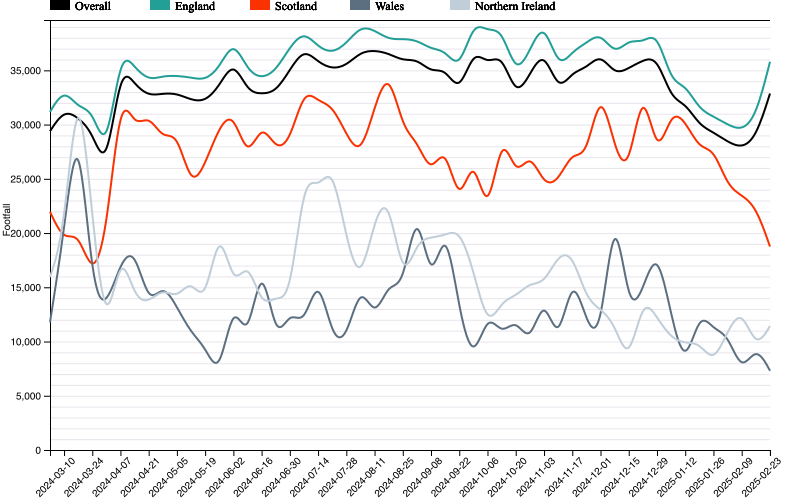
UK Shopping Centres demonstrated an overall uplifting trend during the week ending 23 February 2025 with an average daily footfall of 32,200 visitors. This performance marks a week‑on‑week uplift as well as a moderate year‑on‑year improvement, suggesting that shoppers are returning in greater numbers to the nation's retail environments using proven Location Analytics.
Detailed Performance Trends
A closer look at the week‑on‑week and year‑on‑year comparisons reveals that centres are enjoying a generally positive trajectory even as some key indicators such as dwell time have experienced a slight dip over the week. The average visit duration across UK centres was recorded at 121 minutes. While recent figures suggest a small decline in weekly dwell time, the long‑term trend points to a sharp increase in visitor engagement when compared year‑on‑year.
Regional Variations
When dissected regionally, there are notable variations. Centres in England led the pack with an average daily footfall of 34,800, as both week‑on‑week and year‑on-year growth remained clearly positive with nearly 123 minutes of dwell time supporting enhanced visitor engagement. In contrast, Northern Ireland's centres welcomed 12,100 visitors on an average day, with an impressive 245-minute average visit duration.
Challenges in Scotland and Wales
Scottish centres recorded an average daily footfall of 20,000, with recent data indicating a modest softening and an average dwell time of 83 minutes, marking declines over both short‑term and longer‑term periods. Similarly, centres in Wales experienced an average of 7,400 visitors daily. The weekly trend shows a noticeable downturn in footfall, and even though the dwell time remains at 68 minutes, recent weekly figures have softened, despite a sharp year‑on‑year increase.
Operational Changes in Retail
The retail landscape has been subject to significant operational changes that could be influencing footfall figures. Recent retail news has highlighted both closures and new openings, adding further nuance to the data. For example, reports detailed a closure at a high street fashion chain in Peterborough and several recent closures at a major Sheffield centre, while a global sports brand exited a prominent Scots centre.
Economic Pressures and Weather Impacts
Economic factors continue to exert pressure on the retail sector. Recent reports indicate that consumer confidence remains subdued due to rising costs, while debates continue over whether rising wages will boost spending. Additionally, weather conditions played a role during the analysed week; parts of the UK experienced unusual patterns including freezing rain, snow in northern England, and heavy downpours, which temporarily affected travel and shopping centre performance.
Industry Insights and Future Outlook
Joe Capocci, spokesperson for Huq Industries, observed, “While the data reflects a generally positive trend across UK shopping centres, these figures highlight the importance of understanding regional factors and external influences such as economic conditions and adverse weather.” He added that stakeholders must remain well‑informed with clear, actionable insights. Despite some challenges and regional disparities, the overall picture for UK Shopping Centres remains encouraging as centres work to boost engagement and dwell time.
About Huq Industries
Huq Industries is the leading provider of location intelligence across the UK, Europe, and the Middle East, specialising in delivering high-quality data insights on footfall, consumer behaviour, and retail performance. By leveraging advanced analytics, Huq Industries enables retailers and analysts to understand and respond to market trends effectively, ensuring they are well-equipped to navigate the changing landscape of high street and town centre commerce.
Get the latest intelligence for your locations
Visit StoreFrequently Asked Questions
Clear answers to the most common questions about movement intelligence, retail expansion, and location analytics.
Related Blogs and Insights


.svg)
Empowering strategic teams with the world's most accurate and accessible location intelligence.
Contact

.svg)