.svg)
Week 32, 2025 Retail Parks Update: Insights with Location Analytics
The latest report reveals UK retail parks saw a modest 0.9% weekly dip in daily footfall. Location analytics highlights compelling footfall trends driving market insights.

August 21, 2025
2 min read
Table of contents
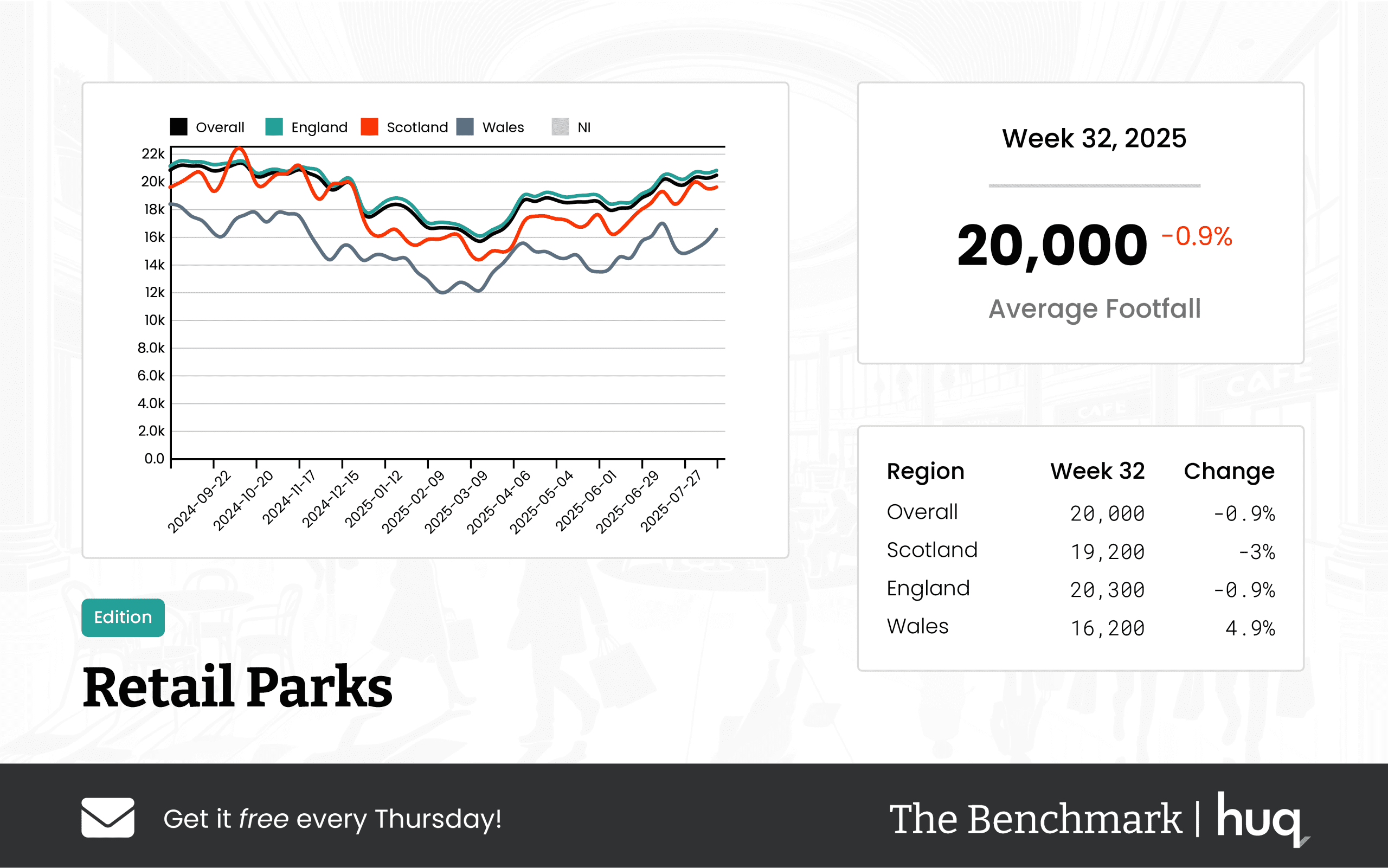
The latest figures from Week 32, 2025 indicate that UK retail parks are experiencing mixed trends as they navigate evolving consumer behaviors. Overall, the parks recorded an average daily footfall of 20,000, marking a slight weekly decline of 0.9% and a more pronounced year-on-year drop of 5.7%. Despite fewer visitors, an in-depth look at dwell times suggests that visit quality remains an important measure of engagement.
Utilising advanced location analytics, industry experts are able to capture subtle shifts in footfall along with visitor dynamics. These insights are vital as retail centres and shopping parks continually adjust to economic climates and shifts in consumer preferences. Regional breakdowns offer a deeper understanding of these trends:
• In Scotland, retail parks observed around 19,200 daily visitors, representing a 3% weekly contraction and a 4.1% annual decline. However, the increased dwell time—averaging 76 minutes—signals that while visitor numbers dipped, the engagement quality improved notably.
• England's figures align closely with the national average, with 20,300 daily visitors. The region experienced the same 0.9% weekly drop and a 5.5% year-on-year decline in footfall. The average dwell time here stayed constant at 70 minutes, indicating a balance between slight short-term and long-term fluctuations.
• Wales presents an interesting case where a 4.9% weekly increase in the average of 16,200 visitors contrasts with an annual decline of 11.7%. Although visitor numbers bounced back in the short term, the dwell time of 60 minutes—rising modestly by 3.4% this week while falling 15.5% year-on-year—raises questions about long-term visitor engagement.
Industry experts are closely monitoring these nuances. Joe Capocci, of Huq Industries, commented on the trends saying, "These figures reveal the most striking change in regional footfall trends with Wales showing a positive weekly recovery, and echo the sentiment in recent retail industry news regarding innovative entry trials at retail parks."
This blend of quantitative footfall data and qualitative dwell measurements highlights the evolving landscape of the UK retail market. As retail parks continue to adapt and innovate, location analytics remains a key tool in understanding where the market is headed and in fine-tuning strategies to enhance visitor engagement and overall performance.
Media: For all media and press enquiries, please contact media@huq.io
Frequently Asked Questions
Clear answers to the most common questions about movement intelligence, retail expansion, and location analytics.
Related Blogs and Insights



.svg)
Empowering strategic teams with the world's most accurate and accessible location intelligence.
Contact

.svg)