.svg)
UK Retail Parks – Week 34 Performance Update, 2025: Location Analytics Insights
In Week 34 2025, UK retail parks experienced a modest rise in daily footfall with location analytics revealing roughly 20,700 visitors on average and evolving footfall trends amidst softer year‐on‐year performance.

September 4, 2025
2 min read
Table of contents
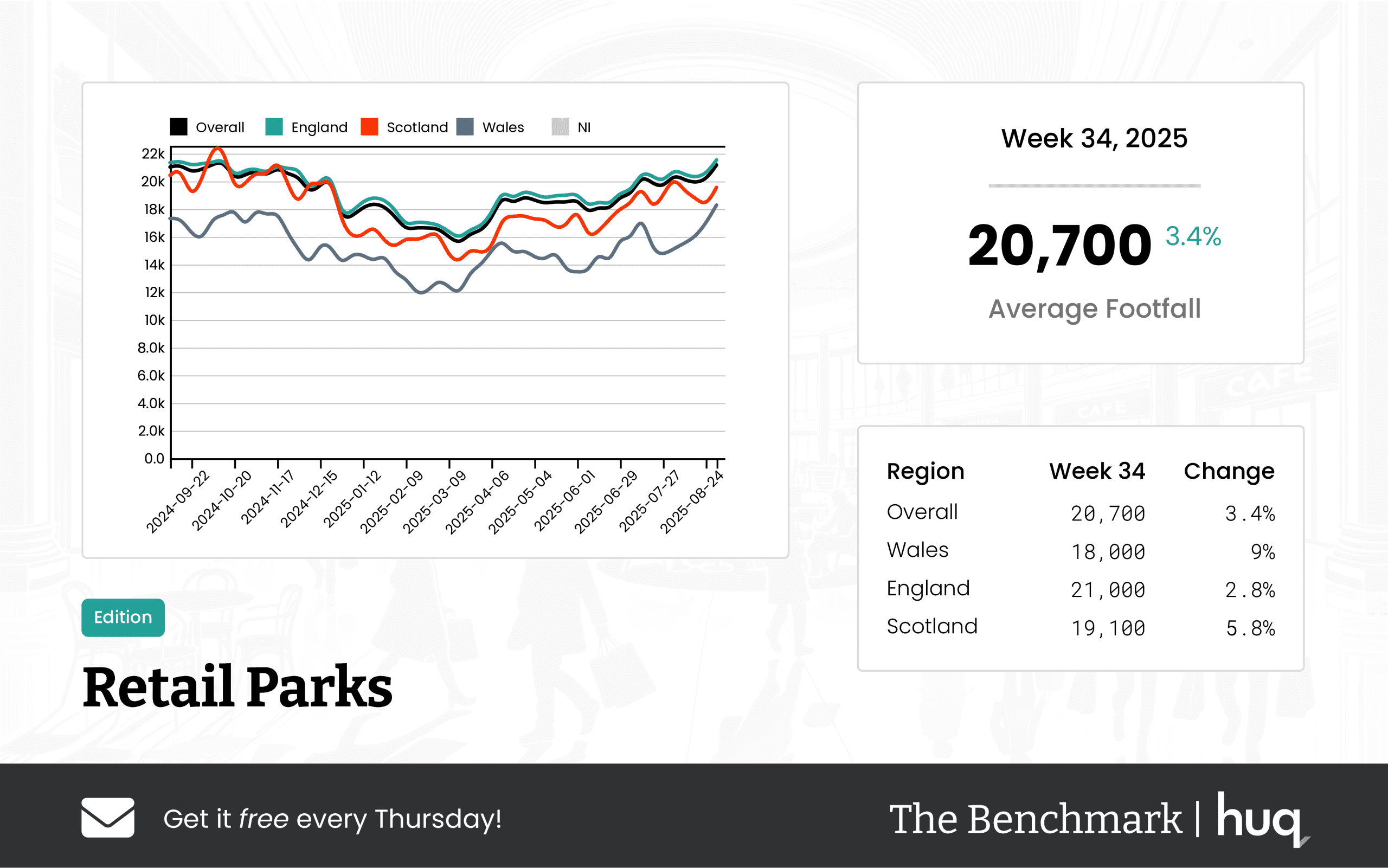
The latest figures from The Benchmark show that UK retail parks recorded an average daily footfall of 20,700 during Week 34 of 2025. While these numbers indicate a modest week-on-week increase in the volume of visitors, a deeper dive into the data reveals softer year-on-year performance and some shifts in shopper behavior.
Across the country, the main indicator has been the increased visitor numbers. However, market analysts note that while the footfall is up, engagement as measured by dwell time has not kept pace, suggesting that a higher stream of visitors does not necessarily translate into more prolonged visits or deeper engagement with retail offerings.
Regional insights further highlight how performance varies across the UK:
• England: Retail parks here saw an average of 21,000 visitors per day. Although the weekly figures are slightly higher, the subtle decline year-on-year points to a stability in visitor flow despite broader challenges in the retail sector.
• Scotland: With an average of 19,100 daily visitors, Scottish retail parks recorded a relatively stronger week-on-week improvement. However, the historical context indicates reduced visitor dwell time, meaning shoppers are spending less time on-site.
• Wales: A notable trend in Wales is the significant 18,000 daily visitor count, which represents a sharp weekly rise. The year-on-year figures are on an upward trend, though the average visit duration remains at 51 minutes, suggesting a disconnection between footfall growth and prolonged visitor engagement.
Overall, the Week 34 performance update offers a nuanced view of the UK retail park sector. While footfall numbers are seeing a positive bump, the softer dwell time and varied regional performance underline the importance of adapting strategies to sustain both visitor numbers and engagement in a competitive retail landscape.
Media: For all media and press enquiries, please contact media@huq.io
Frequently Asked Questions
Clear answers to the most common questions about movement intelligence, retail expansion, and location analytics.
Related Blogs and Insights


.svg)
Empowering strategic teams with the world's most accurate and accessible location intelligence.
Contact

.svg)