.svg)
UK Retail Parks – Week 11 2025 Performance Update: Footfall Data Insights
Overall footfall data shows a 4.2% week-on-week rise despite a 19% year-on-year decline. Increased visitor dwell times offer promising footfall analytics insights.

March 26, 2025
2 min read
Table of contents
Overall Performance
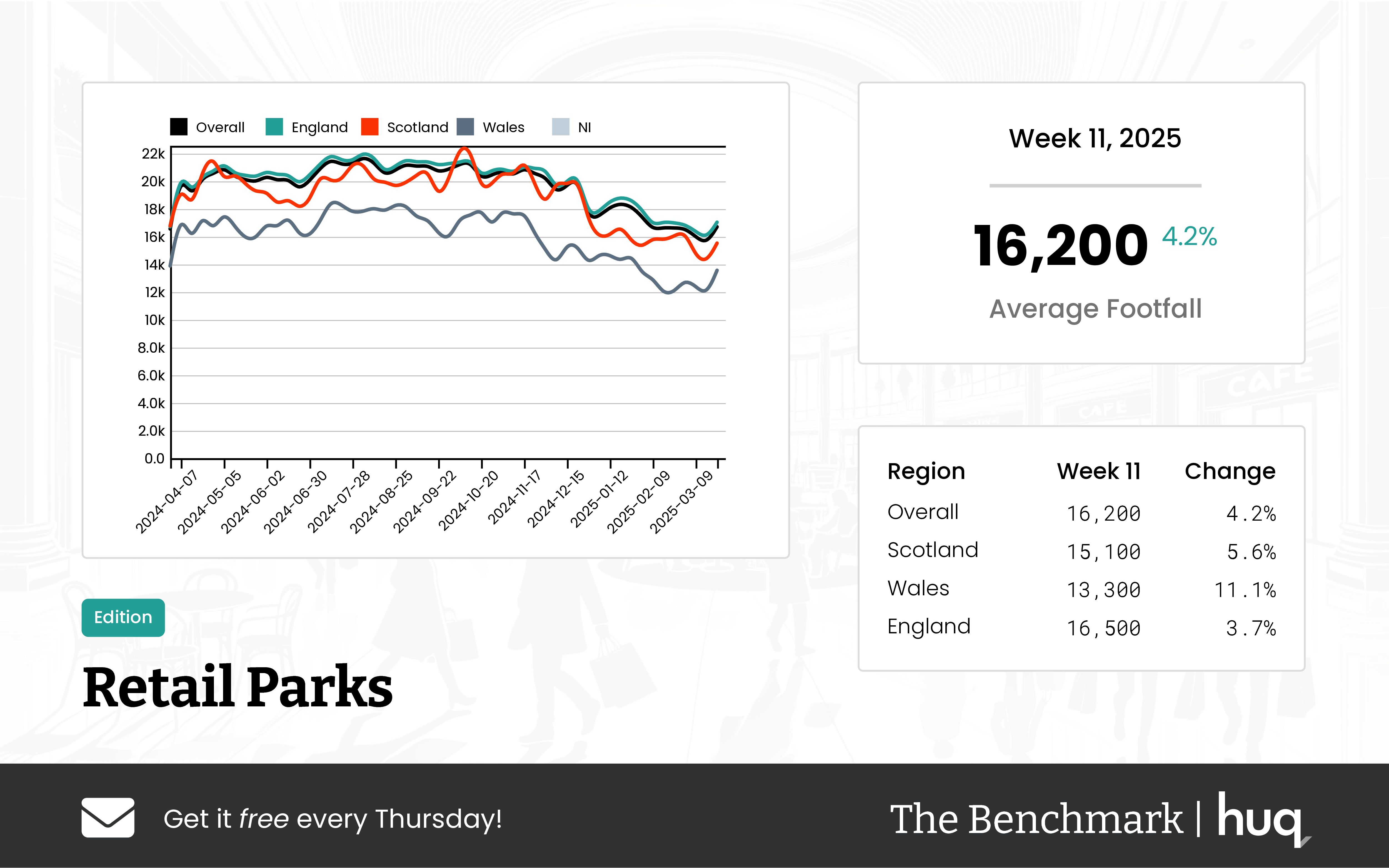
According to recent footfall data, during the week ending 2025-03-23, overall average daily footfall in UK Retail Parks reached 16,200, marking a modest week-on-week rise of 4.2%. However, year-on-year figures indicate a 19% decline, reflecting ongoing challenges in drawing the same level of visitors compared to the previous period. Notably, analysis of visitor behaviour shows that those who do attend are engaging for longer, with the average visit duration now at 73 minutes—up 5.8% from the preceding week and 14.1% from the same period last year.
Regional Overview
In England, Retail Parks recorded an average daily footfall of 16,500, with a 3.7% increase from the previous week, although year-on-year performance depicts an 18.5% decline. Scotland’s parks achieved a weekly growth of 5.6% in average daily footfall, despite experiencing a notable decline on a yearly basis. In Wales, footfall exhibited a healthy week-on-week rise of 11.1%, yet the historical trend still points to a notable decline compared to the previous year. These regional variations underscore the nuanced landscape across the UK Retail Park market. These figures contribute to robust footfall retail insights and provide valuable footfall statistics for market evaluation.
Visitor Dwell Times
Visitor engagement has improved across the regions with overall dwell times trending upward. In England, the average dwell time increased to 72 minutes, registering a modest week-on-week growth of 4.3% and a 9.1% improvement compared to last year. Scotland’s Retail Parks observed an average duration of 78 minutes with a stronger week-on-week jump of 9.9% and a sharp increase in year-on-year performance. In Wales, the average visit extended to 79 minutes, supported by sharp increases in both week-on-week and year-on-year comparisons, further highlighting a trend towards longer visits even amid lower footfall numbers. These improvements in visitor engagement are further underlined by more refined footfall analytics insights, emphasizing the importance of continuous footfall measurement.
Industry Comment
Joe Capocci, spokesperson for Huq Industries, stated, “The healthy 11.1% week-on-week rise in Wales underscores a positive shift in visitor engagement, which is echoed by recent retail developments such as Lidl and Halfords gearing up to open.”
Media: For all media and press enquiries, please contact media@huq.io
About Huq Industries
Huq Industries is the leading provider of location intelligence across the UK, Europe, and the Middle East, specialising in delivering high-quality data insights on footfall, consumer behaviour, and retail performance. By leveraging advanced analytics, Huq Industries enables retailers and analysts to understand and respond to market trends effectively, ensuring they are well-equipped to navigate the changing landscape of high street and town centre commerce.
Get the latest intelligence Benchmark update each Thursday!
Sign Up NowFrequently Asked Questions
Clear answers to the most common questions about movement intelligence, retail expansion, and location analytics.
Related Blogs and Insights



.svg)
Empowering strategic teams with the world's most accurate and accessible location intelligence.
Contact

.svg)