.svg)
UK Major Retail Centres – Week 35, 2025 Performance Update: Location Analytics in Focus
UK Major Retail Centres continue steady performance with visitor numbers up by 0.1% and dwell times rising by 5.4%. Discover how location analytics and footfall trends reveal stronger visitor engagement.

September 12, 2025
2 min read
Table of contents
Overall Performance
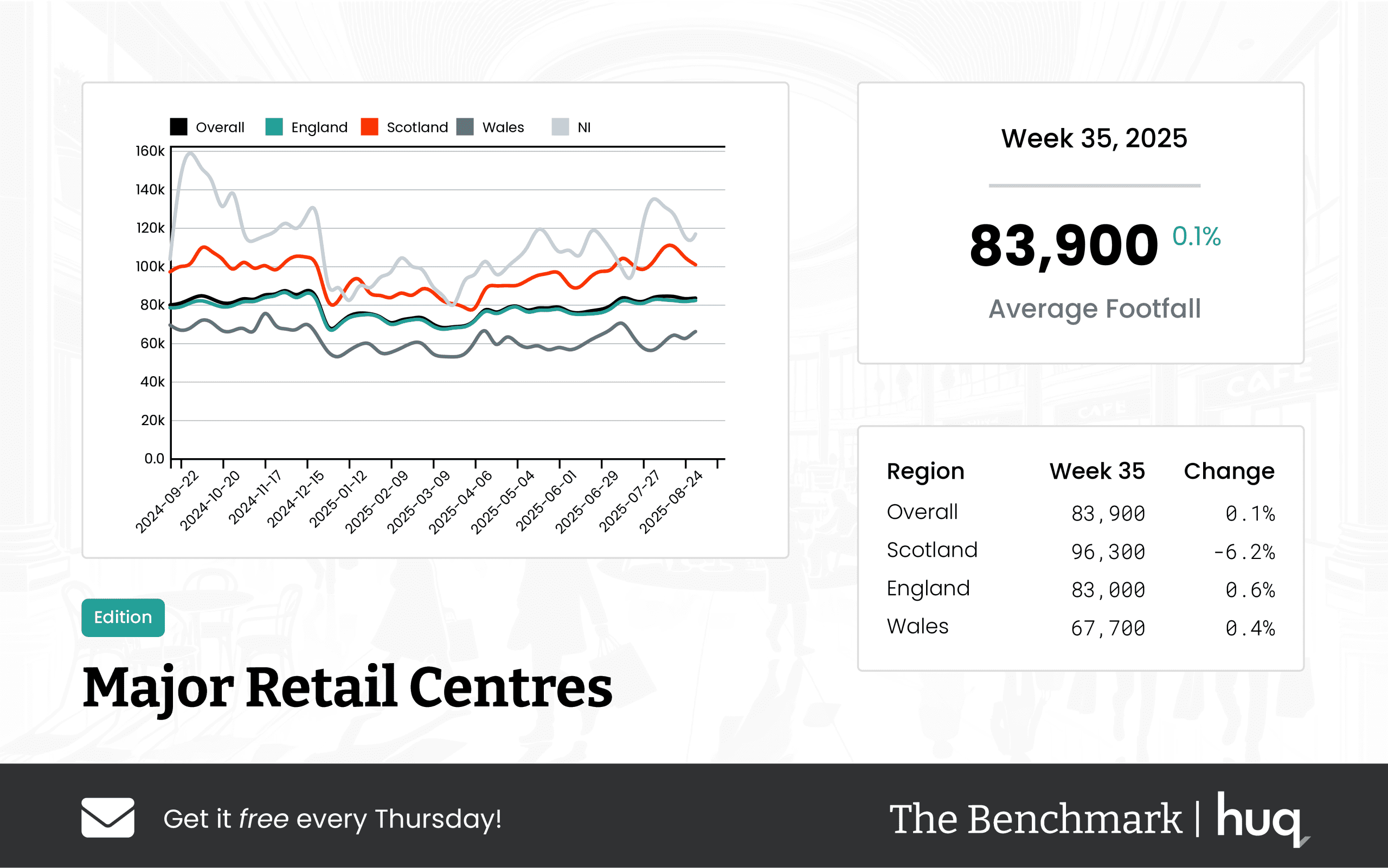
The Benchmark Tracker data indicates a stable performance across UK Major Retail Centres. The week ending 7 September 2025 saw an average daily footfall of 83,900, reflecting a slight week-on-week rise of 0.1% and a robust year-on-year growth of 5.4%.
In addition to improved visitor numbers, location analytics highlights an enhancement in visit quality. The average duration per visit increased to 118 minutes, representing a 1.7% week-on-week improvement and an 8.3% increase compared to last year. This suggests that shoppers are engaging more deeply with the retail environments.
Regional Highlights
Breaking down the data by region reveals varied dynamics. In Scotland, the average daily footfall amounted to 96,300. Despite a 6.2% decrease from the previous week and a slight year-on-year dip of 0.1%, Scottish visitors recorded an average visit duration of 138 minutes. This significant dwell time improvement reflects a positive shift in shopper behavior.
In England, an average of 83,000 daily visitors was observed along with a modest week-on-week increase of 0.6% and a 6.2% improvement compared to last year. The average visit duration in England was 116 minutes, with week and year-on-year increases of 1.8% and 6.4% respectively. These statistics underline steady regional growth and engagement.
Wales demonstrated an average footfall of 67,700, enjoying a slight week-on-week uptick of 0.4% and a 2.4% year-on-year rise. Although the average dwell time here was recorded at 107 minutes per visit and saw a slight decline from the previous week, the overall trends remain positive.
Industry Commentary
Industry leaders and analysts are paying close attention to these trends. Joe Capocci, spokesperson for Huq Industries, noted that the notable decline in Scottish footfall coincided with fashion-oriented events at Liverpool One, emphasizing the importance of data-driven insights in understanding consumer behavior. Such weekly location analytics are proving crucial for optimizing retail strategies in an evolving market.
Collectively, these findings not only showcase the resilience of UK Major Retail Centres but also shed light on how advanced analytics is enhancing our understanding of consumer engagement across different regions.
Media: For all media and press enquiries, please contact media@huq.io
About Huq Industries
Huq Industries is the leading provider of location intelligence across the UK, Europe, and the Middle East, specialising in delivering high-quality data insights on footfall, consumer behaviour, and retail performance. By leveraging advanced analytics, Huq Industries enables retailers and analysts to understand and respond to market trends effectively, ensuring they are well-equipped to navigate the changing landscape of high street and town centre commerce.
Get the latest intelligence Benchmark update each Thursday!
Frequently Asked Questions
Clear answers to the most common questions about movement intelligence, retail expansion, and location analytics.
Related Blogs and Insights


.svg)
Empowering strategic teams with the world's most accurate and accessible location intelligence.
Contact

.svg)