.svg)
UK Major Retail Centres – Week 26, 2025: Footfall Retail Trends and Performance Update
UK retail footfall data trends show a 1.3% rise overall with dwell time up 4.2%, indicating evolving consumer engagement in a competitive environment.

July 10, 2025
2 min read
Table of contents
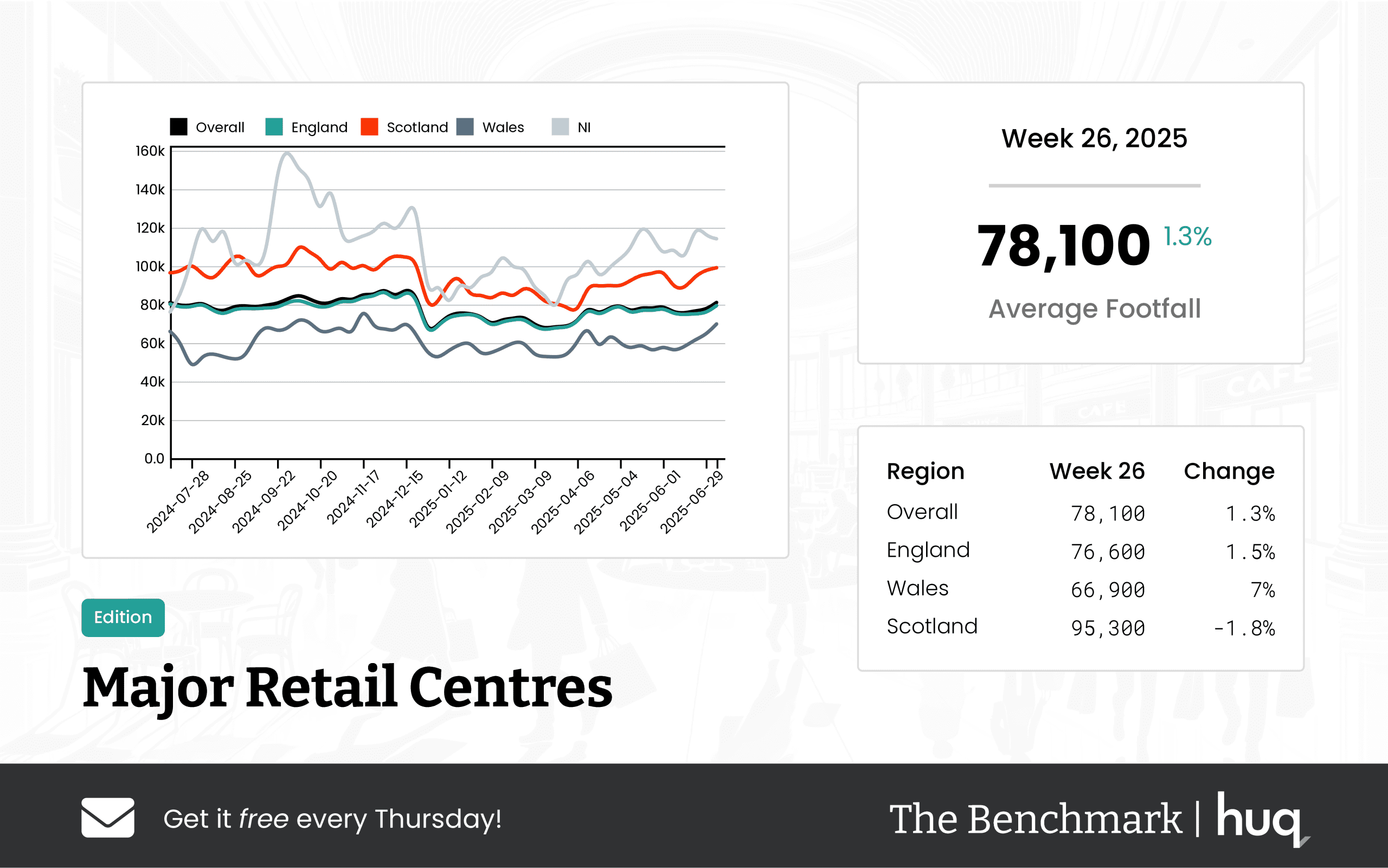
During Week 26, major UK retail centres saw a modest yet positive shift in footfall and visitor engagement. The average daily footfall reached 78,100, marking a 1.3% week-on-week increase, even as year-on-year figures show a slight dip. More notably, visitor dwell time increased by 4.2% to an average of 123 minutes per visit, suggesting that shoppers are spending more time in stores, potentially driven by changing consumer habits and competitive pressures in the retail market.
A closer examination of regional trends presents a varied landscape:
- In England, retail centres welcomed approximately 76,600 visitors daily. Despite a modest decline when compared to the previous year, there was a 1.5% improvement week-on-week, maintaining steady dwell times at 123 minutes and reflecting gradual but positive change.
- Wales outperformed with a robust 7% weekly increase in footfall and an impressive 17.8% year-on-year rise. However, the average visitor spend in Wales decreased to 89 minutes, representing a 19.1% fall week-on-week and 6.3% lower annual figures, indicating that while more shoppers are visiting, they might be spending less time in stores.
- Scotland's centres recorded the highest daily footfall at 95,300 visitors, though they experienced a slight weekly decline of 1.8% and a marginal year-on-year drop. Interestingly, Scottish shoppers are spending more time per visit, with an average dwell time of 137 minutes, supported by a healthy weekly increase.
The shifts in visitor engagement patterns are delivering crucial insights into changing consumer behaviour. Retailers can leverage these dynamics to adjust strategies, optimize in-store experiences, and remain competitive amid evolving market conditions. The detailed analytics underscore that while improvements in footfall and dwell time signal encouraging trends, regional disparities necessitate targeted approaches tailored to local market needs.
Joe Capocci, spokesperson for Huq Industries, remarked, "The sharp increase in Welsh footfall, as observed with its robust weekly performance, aligns with trends noted in recent retail news such as the Foot Locker flagship launch." His comments highlight how broader industry movements influence local retail performance and provide further impetus for retailers to adapt and innovate.
Overall, the data from Week 26 paints an optimistic picture for UK retail centres, marking small yet significant gains in visitor numbers and engagement, and offering actionable insights for businesses aiming to capture the evolving dynamics of consumer behaviour.
Media: For all media and press enquiries, please contact media@huq.io
About Huq Industries
Huq Industries is the leading provider of location intelligence across the UK, Europe, and the Middle East, specialising in delivering high-quality data insights on footfall, consumer behaviour, and retail performance. By leveraging advanced analytics, Huq Industries enables retailers and analysts to understand and respond to market trends effectively, ensuring they are well-equipped to navigate the changing landscape of high street and town centre commerce.
Get the latest intelligence Benchmark update each Thursday!
Frequently Asked Questions
Clear answers to the most common questions about movement intelligence, retail expansion, and location analytics.
Related Blogs and Insights


.svg)
Empowering strategic teams with the world's most accurate and accessible location intelligence.
Contact

.svg)