
Location intelligence report
·
United States
A location intelligence solution for US site decisions
Answer where to open, how a site compares and where visitors come from, with weekly data for any US address. Start with a free report.
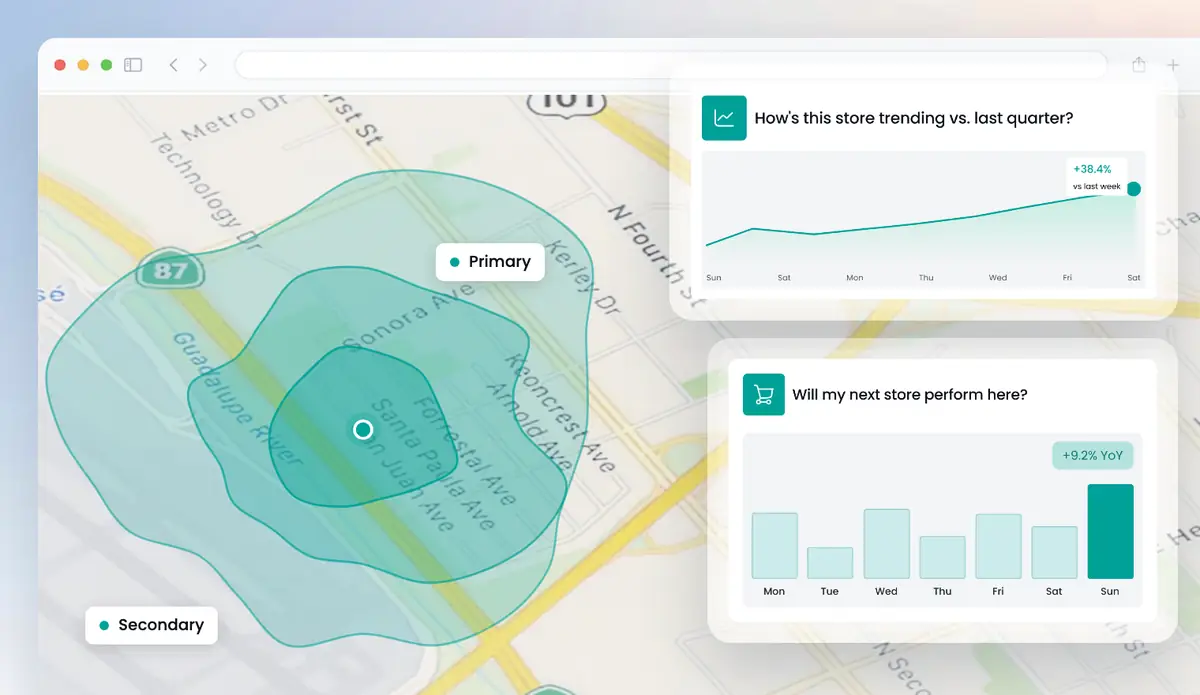
Get a free analysis of your locations
Up to 5 locations. No cost, no commitment.
We handle your details in line with the CCPA and applicable US state privacy laws.
Huq is a location intelligence solution for the decisions that depend on how people use places: where to open, which sites to keep and how an asset compares with its peers. For any US address you see weekly foot traffic, catchment and drive time, dwell time and cross-visitation. Business teams use the Explore map, Projects and PDF reports. Data teams take Parquet or CSV feeds. Start with a free report that answers one real question about one site.
See how Huq works as a location intelligence solution
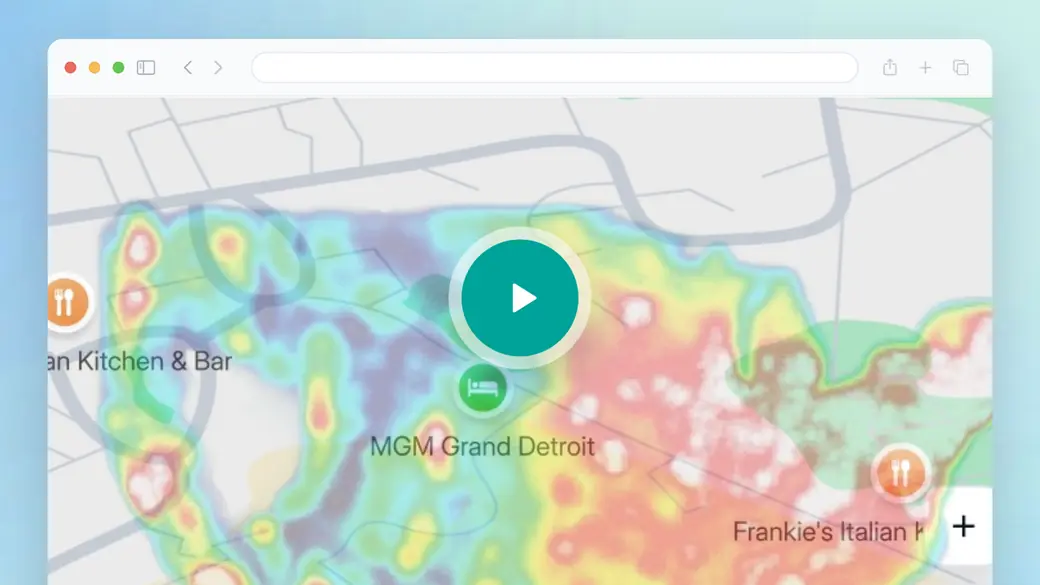
The overview video shows how a question moves through Huq, from picking a site on the Explore map to sharing an answer. Look at who each step suits: the map and Projects for business teams, exports and PDF reports for stakeholders, and data feeds for analysts building their own models.
- Explore map: test a site against nearby brands, shopping centers and drive-time areas before you commit.
- Projects: run the same checks across every site on a shortlist and track each one to a decision.
- Data feeds: give analysts Parquet or CSV files in Amazon S3 or Google Cloud Storage, alongside the platform.
Trusted by 300+ organisations · Data across 35 markets






What is a location intelligence solution?
Location intelligence, sometimes called location-based or spatial intelligence, means drawing insight from geospatial data. A location intelligence solution packages that data with software so teams can answer questions about places. Typical layers include visits, traffic, competitors and trade areas, viewed on maps and dashboards.
The term is used in several fields. Security teams use location-based intelligence for threat monitoring. Fleet operators use it for vehicle tracking. Defense uses geospatial intelligence. In retail, property and investment, it means using measured visits to choose sites, value assets and benchmark performance.
Huq works for that last group. It doesn't do security monitoring, fleet tracking or defense work. It maps each decision to an output: weekly foot traffic for performance, benchmarking against brands and industries for comparison, catchment and drive time for trade areas, and cross-visitation for overlap between sites. More than 1,000 locations are manually validated in each of its 35 markets twice a year.
What's in your location intelligence report
01
Weekly foot traffic trends
How a site is performing week by week, with year-over-year comparison.
02
Benchmarking against nearby competitors
How the site compares with the competitors or peer assets you choose.
03
Catchment and drive time
Where visitors come from and how far they travel, so you can size the trade area.
04
Cross-visitation between your sites
How many visitors two locations share, to test a new site against your existing stores.
What a location intelligence report shows
These views come from Huq's sample report. Yours answers one question about the address you send us.
01
Is this site growing or slipping?
Weekly visits with last year overlaid. A widening gap between the lines is the first sign a site needs attention.
02
How does it compare with its peers?
A benchmark chart ranking the site against nearby competitors on visits, dwell time and visit frequency.
03
Would a new site steal from an existing one?
A cross-visitation matrix for up to 10 location pairs. High shared-visitor share means a new site may take visits from your own stores.
Location intelligence solution coverage across the US
Huq covers any address in the United States: shopping centers, main streets, downtowns, strip malls, competitors' stores and sites you haven't opened yet. No counters, sensors or cameras needed.
Huq manually validates more than 1,000 locations in each of its 35 markets twice a year, and data refreshes weekly.
How it works
Step 1
Tell us your locations
Add up to five addresses in the form. Your own stores, candidate sites or competitors.
Step 2
We run the analysis
Our team maps each location from observed visitor data.
Step 3
We walk you through it
A short call to take you through what the data shows and what it means for you.
Why teams use Huq as their location intelligence solution
- Huq publishes its accuracy by country: a 19.5% median error across published markets, against a 30% healthy threshold.
- Huq's customers give it an NPS of 42.
- Trusted by 300+ organizations across 35 markets, including the global insights, research and location intelligence teams at Nike, Adidas, JD Sports and Samsung.
huq's platform gave us valuable data to support a key decision on potential new sites.
Dan Brogden
National Sales Manager, Puccinos
Who it's for
01
Retail chains of any size
From five-store retailers planning their next site to national brands: choose locations, track store performance and benchmark against competitors.
02
Retail real estate owners
Show shopping center performance, support leasing and get the tenant mix right, for landlords, asset managers and brokers.
03
Investors and private equity
Check how retail brands and assets actually perform before you buy, and monitor them after.
Everything Huq measures, in one platform
- Foot traffic: by week, month and year, with totals, average daily foot traffic, trends, period-over-period change, and visiting vs passing traffic.
- Residents and visitors.
- Trade area and travel time: trade areas by ZIP code, plus drive-time and travel-time analysis.
- Demographics and profiling: age, gender and purchasing power, available in selected markets.
- Behavior: visit frequency, dwell time, time of day and dayparts, cross-visitation between up to 10 location pairs, and international visitation for tourism.
- Foot traffic density and transportation mode.
- Places, brands and industries: points of interest, brand locations and brand analysis, industry performance, shopping center and retail center types.
- Geo-spend: spend by volume and category, available in selected markets.
- Tools: the Explore map (draw any area or use layers for travel time, trade areas, shopping centers, retail centers, brand locations, industries and ZIP codes), White Space Analysis, and Projects for monitoring many locations and reporting to stakeholders.
- Delivery: the platform, CSV or Excel exports, monthly PDF location reports, and data feeds as Parquet and CSV files into Amazon S3 or Google Cloud Storage buckets.
- Cadence: data refreshes weekly.
Frequently asked questions
What is location intelligence?
Location intelligence means drawing decisions from data about places. Business intelligence analyzes internal data such as sales and costs. Location intelligence adds what happens at places, including ones you don't own: visits, catchment and competitor performance. Huq's data feeds load into BI tools so both sit side by side.
Should I choose a platform or a data-only location intelligence solution?
It depends on who will use it. Business teams usually want a platform that answers questions directly. Data teams often want files for their own models. Huq offers both: the Explore map, Projects and monthly PDF reports for business teams, and Parquet or CSV data feeds into Amazon S3 or Google Cloud Storage for data teams.
How often is the data in Huq's location intelligence solution updated?
Huq data updates weekly. Each week adds a new data point to the site's history, so you can see trends build, compare year over year and spot changes after a store opening, closure or refit without waiting for a quarterly report.
Does Huq's location intelligence solution cover the US?
Yes. Huq measures visits to stores, shopping centers, main streets and other addresses across the US, and in 35 markets in total. No sensors or cameras are needed, so you can analyze any address, including a competitor's site, the same way you analyze your own. More than 1,000 locations are manually validated in each market twice a year.
What's in the free location intelligence report?
Send us one US address, yours or a competitor's. We'll prepare a free report showing weekly foot traffic, where visitors come from and how long they stay, then walk you through it. There's no commitment and no hardware to install.
What is location based intelligence?
It is another name for location intelligence. The term also covers security threat monitoring and vehicle tracking, and Huq does neither. Huq measures visits to places such as stores, shopping centers and main streets, to support site, property and investment decisions.
Questions? Talk to us
Book a demoAbout Huq
Huq is a location intelligence company. We turn anonymised mobile location data into footfall, catchment and visitor insight for any place, so retailers, property owners and local authorities can make decisions on evidence.
See how your locations really perform
Up to 5 locations. No cost, no commitment.